
A cylinder of length and radius is placed in an unifrom electric field with its axis parallel to the electric field as shown in the diagram given below. The net electric flux through the cylinder is
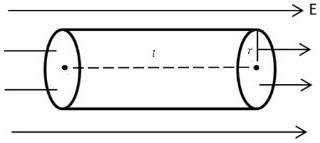
A cylinder of length and radius is placed in an unifrom electric field with its axis parallel to the electric field as shown in the diagram given below. The net electric flux through the cylinder is
Solution
The cylinder is a closed surface in a uniform field, so no net charge is enclosed and the net flux is zero.
Flux entering through the left flat face is , and flux leaving through the right flat face is . On the curved surface, is parallel to the surface, so there.
Option 3: adds the magnitudes of the two flat-face fluxes. It ignores that one is inward (negative) and the other outward (positive).
Options 1 and 2: these use the curved area , but the field is parallel to the curved surface, so it contributes no flux.
Related questions:
2026: 25 May Shift 2
2025: 28 May Shift 1
2026: 30 May Shift 1
2025: 21 May Shift 1