
An equiconvex lens with radii of curvature R each, is put over a liquid layer (refractive index ) poured on top of a plane mirror. A small needle with its tip on the principal axis of the lens is moved along the axis until its inverted real image coincides with the needle itself. The distance of the needle from the lens is measured to be 'x'. On removing the liquid layer and repeating the experiment the distance is found to be 'y'. The value of 'x' can be expressed as:
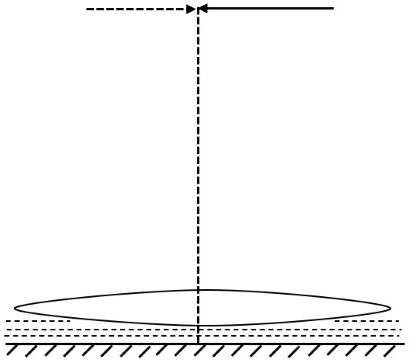
An equiconvex lens with radii of curvature R each, is put over a liquid layer (refractive index ) poured on top of a plane mirror. A small needle with its tip on the principal axis of the lens is moved along the axis until its inverted real image coincides with the needle itself. The distance of the needle from the lens is measured to be 'x'. On removing the liquid layer and repeating the experiment the distance is found to be 'y'. The value of 'x' can be expressed as:
Solution
Light retraces its path only when it strikes the plane mirror normally, so the rays must be parallel between the lens system and the mirror. The needle is therefore at the focal length of whatever lens system sits above the mirror.
Without liquid, the needle is at the focal length of the lens itself, so .
With liquid, the liquid between the lens and the mirror forms a plano-concave lens. Its upper surface follows the convex lower face of the lens (radius ), and its lower surface is flat. Its focal length is given by
The lens and the liquid lens are in contact, so their powers add, and the needle distance equals the combined focal length :
Option 1: not dimensionally consistent, since it adds a length to the pure number .
Related questions:
2025: 26 May Shift 2
2026: 24 May Shift 1
2025: 15 May Shift 1