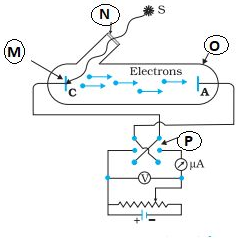
Match List-I with List-II(In the context of a photoelectric effect experiment)
List-I List-II (A) For the emission of photo-electrons (I) governs the maximum kinetic energy of emitted photo-electrons for incident radiation of a particular frequency. (B) Saturation current (II) depends on the intensity of the incident radiation. (C) The stopping potential (III) The frequency of the incident radiation > threshold frequency (D) Work function (IV) measures the maximum kinetic energy of photo-electrons
Match List-I with List-II(In the context of a photoelectric effect experiment)
| List-I | List-II |
|---|---|
| (A) For the emission of photo-electrons | (I) governs the maximum kinetic energy of emitted photo-electrons for incident radiation of a particular frequency. |
| (B) Saturation current | (II) depends on the intensity of the incident radiation. |
| (C) The stopping potential | (III) The frequency of the incident radiation > threshold frequency |
| (D) Work function | (IV) measures the maximum kinetic energy of photo-electrons |
Solution
✅ Correct Option: 1
| List I | List II |
|---|---|
| (A) For the emission of photo-electrons | (III) The frequency of the incident radiation |
| (B) Saturation current | (II) depends on the intensity of the incident radiation |
| (C) The stopping potential | (IV) measures the maximum kinetic energy of photo-electrons |
| (D) Work function | (I) governs the maximum kinetic energy of emitted photo-electrons for incident radiation of a particular frequency |
Einstein's equation ties these together: for a given frequency, the work function decides how much energy is left as maximum kinetic energy. The stopping potential measures that energy through .
Saturation current depends on the number of photons hitting the surface per second, which is the intensity, and not on the frequency.
Related questions:
2026: 30 May Shift 2
2026: 22 May Shift 2
2026: 30 May Shift 2
2025: 29 May Shift 1