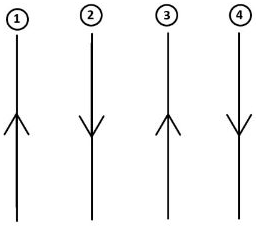
A long straight wire kept in the horizontal plane carries a current. If the magnetic field produced by the wire at a point 2 m east of the wire is in vertically upward direction, the current will be
A long straight wire kept in the horizontal plane carries a current. If the magnetic field produced by the wire at a point 2 m east of the wire is in vertically upward direction, the current will be
Solution
✅ Correct Option: 3
The point is 2 m east of the wire and the field there is vertical, so the wire must run north-south. If the wire ran east-west, the point would lie along the wire's own line, where the field is zero.
Direction: the field direction is , where points from the wire to the point. Here is east. Taking east , north and up , a current from north to south is , so , which is upward.
Magnitude: for a long straight wire,
Related questions:
2026: 22 May Shift 1