
Two p-n junction diodes (ideal) are connected with external resistors and a battery of 2 V and negligible internal resistance as shown in the figure. The current drawn from the battery is
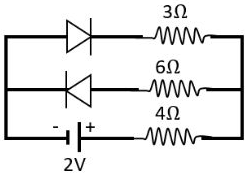
Two p-n junction diodes (ideal) are connected with external resistors and a battery of 2 V and negligible internal resistance as shown in the figure. The current drawn from the battery is
Solution
Current leaves the battery's + terminal, passes through the resistor and then moves leftward through the parallel branches to return to the - terminal.
The upper diode points to the right, so it is reverse biased and carries no current. The lower diode points to the left, so it is forward biased and conducts. As the diodes are ideal, the forward diode has zero resistance.
Only the and resistors are in the circuit, in series:
Option 3: 0.33 A would result from ignoring the and branches' diode directions and using wrong resistance; 0.15 A would result from treating both branches as conducting in parallel (, total gives A), which is the common mistake of ignoring the reverse-biased diode.
Related questions:
2025: 19 May Shift 1
2025: 28 May Shift 1
2026: 30 May Shift 2
2026: 14 May Shift 2
2025: 16 May Shift 1