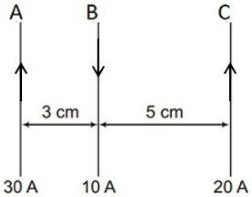
Equal currents are flowing in four infinitely long wires. The distance between each other is the same and directions of currents are as shown in the figure. The net force on wire 2 is
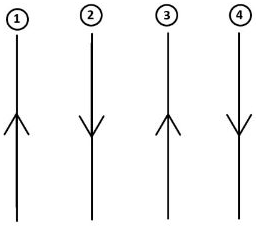
Equal currents are flowing in four infinitely long wires. The distance between each other is the same and directions of currents are as shown in the figure. The net force on wire 2 is
Solution
✅ Correct Option: 3
Take the wires at positions . Parallel currents in the same direction attract and opposite currents repel. Let , so the force between two wires a distance apart is .
| Wire acting on wire 2 | Currents | Nature | Direction on wire 2 | Magnitude |
|---|---|---|---|---|
| 1 | opposite | repulsion | right | |
| 3 | opposite | repulsion | left | |
| 4 | same | attraction | right |
The forces from wires 1 and 3 cancel, leaving only the pull from wire 4.
Option 2: wire 1 is pushed to the left (repelled by 2 and 4, pulled right only by 3), and its net force is , so it does not equal the force on wire 2.
Related questions:
2026: 18 May Shift 1