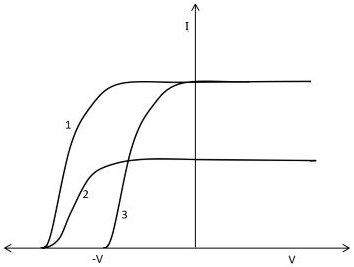
Read the following features of the Photoelectric effect.
(A) The maximum kinetic energy of the photoelectrons varies linearly with the frequency of incident radiation
(B) The maximum kinetic energy of the photoelectrons is dependent on its intensity.
(C) For a frequency of incident radiation, lower than the cut-off frequency, photoelectric emission is possible even if the intensity is not large.
(D) Ultraviolet light can eject photoelectrons from copper even if visible light does not eject
Solution
Einstein's equation shows that is a linear function of the frequency , so (A) is true.
Copper has a work function that is higher than the energy of visible photons but lower than that of ultraviolet photons. So ultraviolet light (higher ) can eject photoelectrons from copper while visible light cannot, so (D) is true.
(B): depends on frequency and work function, not on intensity. Intensity only changes the number of photoelectrons, and so the photocurrent.
(C): Below the cut-off frequency no emission occurs, however intense the light is. Intensity cannot make up for low photon energy.
Related questions:
2026: 31 May Shift 2
2026: 6 June Shift 1