
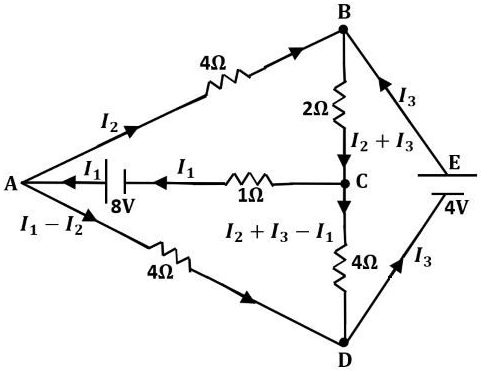
Applying the Kirchhoff's rule to the loop (a) ABCA and (b) BCDEB, two correct equations are given
(A)
(B)
(C)
(D)
Applying the Kirchhoff's rule to the loop (a) ABCA and (b) BCDEB, two correct equations are given
(A)
(B)
(C)
(D)
Solution
✅ Correct Option: 1
Take loop ABCA in the direction A to B to C to A, using the currents marked in the figure. The 8 V cell is a gain, and each resistor in the direction of current is a drop:
This is equation (A).
Take loop BCDEB in the direction B to C to D to E to B. The 4 V cell is a gain, and the and resistors are drops:
This is equation (B).
Options (C) and (D): the current in the resistor is , not . Also, in (D) the term has the wrong sign, because travelling along the current gives a drop, .
Related questions:
2025: 2 June Shift 1
2025: 3 June Shift 1
2025: 22 May Shift 1