
Match List-I with List-II
List-I (Statement) List-II (Energy band diagram) (A) An intrinsic semiconductor at T = 0 K (I) 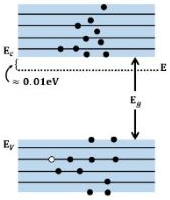
(B) An intrinsic semiconductor at T > 0 K with thermally generated electron-hole pairs. (II) 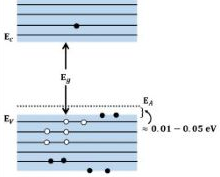
(C) Energy bands of n-type semiconductor at T > 0 K (III) 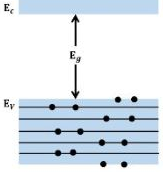
(D) Energy bands of p-type semiconductor at T > 0 K (IV) 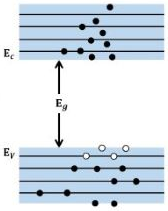
Match List-I with List-II
| List-I (Statement) | List-II (Energy band diagram) |
|---|---|
| (A) An intrinsic semiconductor at T = 0 K | (I) |
| (B) An intrinsic semiconductor at T > 0 K with thermally generated electron-hole pairs. | (II) |
| (C) Energy bands of n-type semiconductor at T > 0 K | (III) |
| (D) Energy bands of p-type semiconductor at T > 0 K | (IV) |
Solution
✅ Correct Option: 4
| List I | List II |
|---|---|
| (A) Intrinsic semiconductor at T = 0 K | (III) Valence band completely full, conduction band empty |
| (B) Intrinsic semiconductor at T > 0 K | (IV) Equal numbers of electrons in the conduction band and holes in the valence band |
| (C) n-type semiconductor at T > 0 K | (I) Donor level about 0.01 eV below , with many electrons in the conduction band and few holes |
| (D) p-type semiconductor at T > 0 K | (II) Acceptor level just above , with many holes in the valence band and few electrons in the conduction band |
Donor level means n-type (extra electrons). Acceptor level means p-type (extra holes).
Related questions:
2026: 6 June Shift 1
2025: 27 May Shift 2
2026: 15 May Shift 1
2026: 7 June Shift 2