
There is a small air bubble inside a glass sphere of radius 10 cm. The bubble is 4.0 cm below the surface and is viewed normally from outside as shown. The apparent depth of the bubble will be
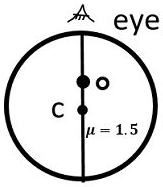
There is a small air bubble inside a glass sphere of radius 10 cm. The bubble is 4.0 cm below the surface and is viewed normally from outside as shown. The apparent depth of the bubble will be
Solution
Light goes from the bubble (in glass) to the eye (in air), so use refraction at a single spherical surface, taking the direction of light as positive:
Here , , cm. The centre of curvature lies on the incident side (inside the sphere), so cm.
cm
The negative sign means the image is virtual, on the same side as the bubble, so it appears about 3.0 cm below the surface.
Option 2: cm is the real depth, and the image always forms at a different position.
Option 1: this would need light bending away from the normal on entering a denser medium, which is the reverse of what happens here.
Using the flat-surface formula cm ignores the curvature of the sphere, which is why the spherical formula is needed.
Related questions:
2026: 30 May Shift 2
2026: 21 May Shift 1
2025: 13 May Shift 1
2025: 27 May Shift 2
2025: 3 June Shift 2