
The equivalent resistance between P and Q is:
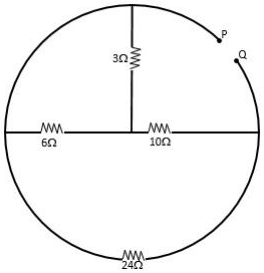
The equivalent resistance between P and Q is:
Solution
✅ Correct Option: 1
The circle is plain wire except for the resistor at the bottom. The arc from P through the top end of the resistor to the left end of the resistor has no resistance. So the outer ends of the and resistors are at the same potential as P. Similarly, the outer end of the resistor is at the same potential as Q.
The and resistors both run from the centre to P, so they are in parallel:
This is in series with the resistor (centre to Q):
The resistor joins P and Q directly, so it is in parallel with :
Related questions:
2025: 16 May Shift 1
2026: 18 May Shift 2