
The graphs of stopping potential versus frequency of incident radiation for two metals Ⓐ and Ⓑ are given.
Identify the correct statement(s) from the following
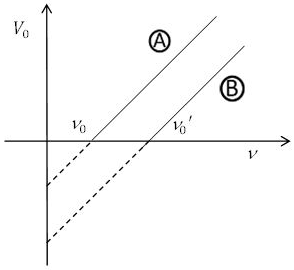
(A) The slope of the graphs is equal to the Planck's constant.
(B) Intercept on the (-y) axis is equal to (work function/e).
(C) Threshold frequency for metal Ⓐ is higher than metal Ⓑ
(D) Work function for metal Ⓑ is greater than metal Ⓐ
The graphs of stopping potential versus frequency of incident radiation for two metals Ⓐ and Ⓑ are given.
Identify the correct statement(s) from the following
(A) The slope of the graphs is equal to the Planck's constant.
(B) Intercept on the (-y) axis is equal to (work function/e).
(C) Threshold frequency for metal Ⓐ is higher than metal Ⓑ
(D) Work function for metal Ⓑ is greater than metal Ⓐ
Solution
Einstein's photoelectric equation gives , so .
The intercept on the axis has magnitude , so (B) is correct.
The work function is . Metal Ⓑ has the larger threshold frequency (), so its work function is greater than that of Ⓐ, and (D) is correct.
(A): the slope is , not . The lines are parallel because is the same for all metals.
(C): the threshold frequency of Ⓐ is , which is less than for Ⓑ, so Ⓐ has the lower threshold frequency.
Related questions:
2025: 13 May Shift 1
2026: 31 May Shift 2