Q1:

2025: 29 May Shift 2

Solutions

Easy

The osmotic pressure is one of the four colligative properties which depends on the number of particles of solute in the solution, irrespective of their nature. The osmotic pressure is equal to the product of concentration, gas constant and temperature. It is the most commonly used property for the determination of the molar mass of biomolecules. In many situations, the molecules get dissociated or associated when they are dissolved in a solvent, thereby changing the number of molecules in the solution. As a result, an abnormal molecular mass is obtained. The extent of dissociation or association is given by van't Hoff factor (ii), which is the ratio of normal molar mass to abnormal molar mass. It is related with the degree of association or ionization. The introduction of van't Hoff factor in the osmotic pressure equation modifies the equation.

Osmotic pressure (Π\Pi) of a solution does not depend upon

Answer options
Option 4
Correct Answer
Explanation for 2025: 29 May Shift 2 CHE question 1

Q2:

2025: 29 May Shift 2

Solutions

Easy

The osmotic pressure is one of the four colligative properties which depends on the number of particles of solute in the solution, irrespective of their nature. The osmotic pressure is equal to the product of concentration, gas constant and temperature. It is the most commonly used property for the determination of the molar mass of biomolecules. In many situations, the molecules get dissociated or associated when they are dissolved in a solvent, thereby changing the number of molecules in the solution. As a result, an abnormal molecular mass is obtained. The extent of dissociation or association is given by van't Hoff factor (ii), which is the ratio of normal molar mass to abnormal molar mass. It is related with the degree of association or ionization. The introduction of van't Hoff factor in the osmotic pressure equation modifies the equation.

What is the value of the van't Hoff factor for NaCl, K2SO4\text{K}_2\text{SO}_4 and KCl, respectively ?

Answer options
Option 4
Correct Answer
Explanation for 2025: 29 May Shift 2 CHE question 2

Q3:

2025: 29 May Shift 2

Solutions

Easy

The osmotic pressure is one of the four colligative properties which depends on the number of particles of solute in the solution, irrespective of their nature. The osmotic pressure is equal to the product of concentration, gas constant and temperature. It is the most commonly used property for the determination of the molar mass of biomolecules. In many situations, the molecules get dissociated or associated when they are dissolved in a solvent, thereby changing the number of molecules in the solution. As a result, an abnormal molecular mass is obtained. The extent of dissociation or association is given by van't Hoff factor (ii), which is the ratio of normal molar mass to abnormal molar mass. It is related with the degree of association or ionization. The introduction of van't Hoff factor in the osmotic pressure equation modifies the equation.

How is the osmotic pressure of a concentrated solution related to the osmotic pressure of a dilute solution of the same substance at a given temperature?

Answer options
Option 3
Correct Answer
Explanation for 2025: 29 May Shift 2 CHE question 3

Q4:

2025: 29 May Shift 2

Solutions

Medium

The osmotic pressure is one of the four colligative properties which depends on the number of particles of solute in the solution, irrespective of their nature. The osmotic pressure is equal to the product of concentration, gas constant and temperature. It is the most commonly used property for the determination of the molar mass of biomolecules. In many situations, the molecules get dissociated or associated when they are dissolved in a solvent, thereby changing the number of molecules in the solution. As a result, an abnormal molecular mass is obtained. The extent of dissociation or association is given by van't Hoff factor (ii), which is the ratio of normal molar mass to abnormal molar mass. It is related with the degree of association or ionization. The introduction of van't Hoff factor in the osmotic pressure equation modifies the equation.

The osmotic pressure of a 0.1 M aqueous solution of K2SO4\text{K}_2\text{SO}_4 is 4.92 atm at 300 K. The percentage ionization of the salt is:

(Given RR = 0.082 atm L K−1\text{K}^{-1} mol−1\text{mol}^{-1})

Answer options
Option 1
Correct Answer
Explanation for 2025: 29 May Shift 2 CHE question 4

Q5:

2025: 29 May Shift 1

Solutions

Medium

Match List-I with List-II

List-IList-II
SolutionProperties
(A) Phenol and aniline(I) Minimum boiling Azeotrope
(B) Nitric acid and water(II) Maximum boiling Azeotrope
(C) Ethanol and water(III) Hydrogen bonding
(D) Benzene and toluene(IV) Ideal solution
Answer options
Option 3
Correct Answer
Explanation for 2025: 29 May Shift 1 CHE question 5

Q6:

2025: 29 May Shift 1

Solutions

Medium

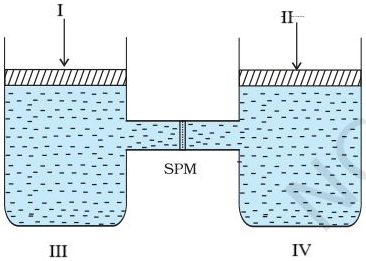
In the following diagram, to prevent osmosis, if excess pressure is applied on one side of the semipermeable membrane (SPM), then I, II, III and IV are, respectively,

Figure

(A) Solution

(B) PatmP_{atm}

(C) Patm+ΠP_{atm} + \Pi

(D) Solvent

Answer options
Option 4
Correct Answer
Explanation for 2025: 29 May Shift 1 CHE question 6

Q7:

2025: 29 May Shift 1

Solutions

Easy

Which of the following statements are correct for dilute solutions?

(A). The elevation in boiling point is directly proportional to the molality of the solution.

(B). The elevation in boiling point is inversely proportional to the molality of the solution.

(C). The depression in freezing point is directly proportional to the molality of the solution.

(D). The depression in freezing point is inversely proportional to the molality of the solution.

Answer options
Option 2
Correct Answer
Explanation for 2025: 29 May Shift 1 CHE question 7

Q8:

2025: 29 May Shift 1

Solutions

Easy

Which one of the following correctly represents the concentration term 'ppm'?

Answer options
Option 3
Correct Answer
Explanation for 2025: 29 May Shift 1 CHE question 8

Q9:

2025: 29 May Shift 1

Solutions

Easy

Which among the following shows positive deviation from Raoult's law?

Answer options
Option 1
Correct Answer
Explanation for 2025: 29 May Shift 1 CHE question 9

Q10:

2025: 28 May Shift 2

Solutions

Medium

Arrange the following solutions in increasing order of their concentration.

(A) 7.5 g KCl (74.5 g mol−1\text{mol}^{-1}) in 100 mL solution

(B) 3 g Urea ( 60 g mol−1\text{mol}^{-1}) in 1 L solution

(C) 3.6 g glucose (180 g mol−1\text{mol}^{-1}) in 100 mL solution

(D) 4 g NaOH (40 g mol−1\text{mol}^{-1}) in 1 L solution

Answer options

Q11:

2025: 28 May Shift 2

Solutions

Medium

Which of the following statements is/are incorrect?

Answer options

Q12:

2025: 28 May Shift 2

Solutions

Easy

The osmotic pressure of the equimolar solutions of the following at the same temperature will increase in order

(A) NaCl

(B) K2SO4K_2SO_4

(C) K3[Fe(CN)6]K_3[Fe(CN)_6]

(D) NH2CONH2NH_2CONH_2

Answer options

Q13:

2025: 28 May Shift 2

Solutions

Medium

Match List-I with List-II

Aqueous SolutionsDepression in freezing point (ΔTf\Delta T_f) expression
(A) 0.2 mol kg−1\text{kg}^{-1} Al2(SO4)3Al_2(SO_4)_3(I) 2Kf2K_f
(B) 0.3 mol kg−1\text{kg}^{-1} Na2SO4Na_2SO_4(II) KfK_f
(C) 1 mol kg−1\text{kg}^{-1} KCl(III) 0.9Kf0.9K_f
(D) 0.1 mol kg−1\text{kg}^{-1} K3[Fe(CN)6]K_3[Fe(CN)_6](IV) 0.4Kf0.4K_f
Answer options

Q14:

2025: 28 May Shift 2

Solutions

Medium

Match List-I with List-II

List-IList-II
Components of binary solutionDeviation from Raoult's Law
(A) Ethanol and water(I) Positive
(B) Chloroform and acetone(II) No deviation
(C) n-Hexane and n-heptane(III) Negative
(D) Carbon disulphide and acetone(IV) Large positive
Answer options

Q15:

2025: 28 May Shift 1

Solutions

Easy

The correct relation for determining the molar mass of solute (M2M_2) using osmotic pressure measurement, is

Answer options

Q16:

2025: 28 May Shift 1

Solutions

Medium

For binary solution of two liquids, A and B

Match List-I with List-I

List-IList-II
Inter-molecular interactionBehavior
(A). A-A & B-B are nearly equal to A-B(I). Negative deviation from Raoult's Law
(B). A-A & B-B are stronger compared to A-B(II). Azeotropes
(C). A-A & B-B are weaker compared to A-B(III). Positive deviation from Raoult's Law
(D). Very strong A-B interaction(IV). No deviation from Raoult's Law
Answer options

Q17:

2025: 28 May Shift 1

Solutions

Easy

The flow of solvent from pure solvent side to solution side across a semipermeable membrane can be stopped if some extra pressure is applied on the solution. This pressure that just stops the flow of solvent is called

Answer options

Q18:

2025: 28 May Shift 1

Solutions

Easy

Azeotropes are binary mixtures having

Answer options

Q19:

2025: 28 May Shift 1

Solutions

Easy

The van't Hoff Factor, ii for complete dissociation of (i) NaCl, (ii) MgSO4MgSO_4 and (iii) K2SO4K_2SO_4 are

Answer options

Q20:

2025: 27 May Shift 2

Solutions

Easy

The molality of solution obtained by dissolving 1.5 g of ethanoic acid (CH3COOH\mathrm{CH_3COOH}) in 25g of benzene is:

Answer options

Q21:

2025: 27 May Shift 2

Solutions

Medium

The vapour pressure of pure water at 25 °C is 23.75 mmHg. The vapor pressure of the solution obtained by dissolving 34.2 g of sucrose (C12H22O11\mathrm{C_{12}H_{22}O_{11}}) in 100 g of water will be:

Answer options

Q22:

2025: 27 May Shift 2

Solutions

Easy

Match List-I with List-II

List-IList-II
(Type of solution)(Examples)
(A) Gas in liquid(I) Brass
(B) liquid in liquid(II) Benzene in Toluene
(C) liquid in solid(III) Aerated drinks
(D) solid in solid(IV) Mercury in gold
Answer options

Q23:

2025: 27 May Shift 2

Solutions

Medium

A solution containing 10 g/dm3\mathrm{dm^3} of urea (NH2CONH2\mathrm{NH_2CONH_2}) is isotonic with a 10% solution of a non-volatile solute. The molecular mass of the solute is:

Answer options

Q24:

2025: 27 May Shift 2

Solutions

Medium

The degree of dissociation (α\alpha) of a weak electrolyte AxBy\mathrm{A_xB_y} is related to van't Hoff factor (ii) by the expression:

Answer options

Q25:

2025: 26 May Shift 2

Solutions

Medium

Vapour pressures of chloroform(CHCl3_3) and dichloromethane (CH2_2Cl2_2) at 298 K are 200 mmHg and 415 mmHg, respectively. Calculate the vapor pressure of the solution prepared by mixing 0.2 mol of CHCl3_3 and 0.5 mol of CH2_2Cl2_2 at 298 K

Answer options

Q26:

2025: 26 May Shift 2

Solutions

Medium

Choose the correct statements from the following:

(A) two different solutions of sucrose of same molality prepared in different solvents will have the same depression in freezing point.

(B) the osmotic pressure of a solution is given by the equation Π=CRT\Pi = CRT (where C is the molarity of the solution)

(C) decreasing order of osmotic pressure for 0.01 M aqueous solution of BaCl2_2, KCl, CH3_3COOH and sucrose is

BaCl2_2 > KCl > CH3_3COOH > sucrose

(D) according to Raoult's law the vapor pressure exerted by a volatile component of a solution is directly proportional to its mole fraction in the solution

Answer options

Q27:

2025: 26 May Shift 2

Solutions

Easy

2.5 g of the following substances are dissolved in 500 mL of water. Arrange the resultant solutions in increasing order of their molarity;

(A) C6_6H12_{12}O6_6 (180 g mol−1^{-1})

(B) NH2_2CONH2_2 (60 g mol−1^{-1})

(C) NaCl (58.5 g mol−1^{-1})

(D) MgSO4_4 (120 g mol−1^{-1})

Answer options

Q28:

2025: 26 May Shift 2

Solutions

Medium

Calculate the lowering of vapour pressure caused by the addition of 50 g of sucrose (mol mass = 342 g mol−1^{-1}) to 750 g of water, if the vapour pressure of pure water at 25°C is 23.8 mm Hg.

Answer options

Q29:

2025: 26 May Shift 2

Solutions

Easy

The reverse osmosis occurs when

Answer options

Q30:

2025: 24 May Shift 2

Solutions

Easy

Match List-I with List-II

List-IList-II
Concentration termFormula
(A) Mass percentage(I) Volume of soluteVolume of solution×100\frac{\text{Volume of solute}}{\text{Volume of solution}} \times 100
(B) Volume percentage(II) Moles of a componentTotal moles of all the components\frac{\text{Moles of a component}}{\text{Total moles of all the components}}
(C) Mole Fraction(III) Moles of soluteMass of solvent in kg\frac{\text{Moles of solute}}{\text{Mass of solvent in kg}}
(D) Molality(IV) Mass of soluteVolume of solution×Density of solution×100\frac{\text{Mass of solute}}{\text{Volume of solution} \times \text{Density of solution}} \times 100
Answer options