Q1:

2026: 19 May Shift 1

Solutions

Medium

Match List-I with List-II

List-IList-II
Solution typeExamples
(A) Minimum boiling azeotrope(I) Chloroform/Acetone
(B) Maximum boiling azeotrope(II) Ethanol/Acetone
(C) Negative deviation from Raoult's law(III) 95% Ethanol/water
(D) Positive deviation from Raoult's law(IV) 68% HNO3/H2OHNO_3/H_2O
Answer options
Option 4
Correct Answer
Explanation for 2026: 19 May Shift 1 CHE question 1

Q2:

2026: 19 May Shift 1

Solutions

Easy

Why is a cellulose acetate membrane used in reverse osmosis?

Answer options
Option 2
Correct Answer
Explanation for 2026: 19 May Shift 1 CHE question 2

Q3:

2026: 19 May Shift 1

Solutions

Easy

Arrange the following solutions in increasing order of their boiling point:

(A) 1% glucose

(B) 2% glucose

(C) 3% glucose

(D) 4% glucose

Answer options
Option 4
Correct Answer
Explanation for 2026: 19 May Shift 1 CHE question 3

Q4:

2026: 19 May Shift 1

Solutions

Easy

Calculate the molarity (mol L−1L^{-1}) of a solution containing 25 g of C2H5OHC_2H_5OH in 675 mL solution.

Answer options
Option 3
Correct Answer
Explanation for 2026: 19 May Shift 1 CHE question 4

Q5:

2026: 19 May Shift 1

Solutions

Easy

Which of following are solid solutions?

(A) Solution of hydrogen in palladium

(B) Camphor in nitrogen gas

(C) Copper dissolved in gold

(D) Amalgum of mercury with sodium

Answer options
Option 4
Correct Answer
Explanation for 2026: 19 May Shift 1 CHE question 5

Q6:

2026: 18 May Shift 2

Solutions

Easy

Two solutions having the same osmotic pressure at a given temperature are called:

Answer options
Option 2
Correct Answer
Explanation for 2026: 18 May Shift 2 CHE question 6

Q7:

2026: 18 May Shift 2

Solutions

Easy

Match the LIST-I with LIST-II

LIST-I Type of solutionLIST-II Example
A.Solid solute in solid solventI.Glucose dissolved in water
B.Gaseous solute in solid solventII.Copper dissolved in gold
C.Liquid solute in solid solventIII.Amalgam of mercury with sodium
D.Solid solute in liquid solventIV.Solution of hydrogen in palladium
Answer options
Option 2
Correct Answer
Explanation for 2026: 18 May Shift 2 CHE question 7

Q8:

2026: 18 May Shift 2

Solutions

Medium

Match the LIST-I with LIST-II.

LIST-I Binary solutionLIST-II Type of solution
A.n-Hexane and n-HeptaneI.Isotonic with fluid inside blood cell
B.Nitric acid and WaterII.Minimum boiling azeotrope
C.0.9 % sodium chloride solutionIII.Ideal solution
D.Ethanol and WaterIV.Maximum boiling azeotrope
Answer options
Option 4
Correct Answer
Explanation for 2026: 18 May Shift 2 CHE question 8

Q9:

2026: 18 May Shift 2

Solutions

Medium

Arrange the following aqueous solutions of urea in increasing order of their freezing point?

A. 2% (w/v)

B. 10% (w/v)

C. 8% (w/v)

D. 5 % (w/v)

Answer options
Option 3
Correct Answer
Explanation for 2026: 18 May Shift 2 CHE question 9

Q10:

2026: 18 May Shift 2

Solutions

Easy

Which of the following gases will have the lowest solubility in water at pressure pp and temperature 293 K?

(Given: Henry's constant (kbar) at 293 K for He, H2H_2, N2N_2 and O2O_2 are 144.97, 69.16, 76.48 and 34.86, respectively)

Answer options

Q11:

2026: 18 May Shift 1

Solutions

Easy

Aquatic species are more comfortable in cold water due to

Answer options

Q12:

2026: 18 May Shift 1

Solutions

Easy

Henry's law discusses about:

Answer options

Q14:

2026: 18 May Shift 1

Solutions

Medium

The increasing order of solubilty in water at 298 K, of the following gases is

(A) Carbon dioxide (KHK_H = 1.67 kbar)

(B) Vinyl chloride (KHK_H = 0.611 kbar)

(C) Methane (KHK_H = 0.413 kbar)

(D) Formaldehyde (KH=1.83×10⁻⁵K_H = 1.83 \times 10^{-5} kbar)

Answer options

Q15:

2026: 18 May Shift 1

Solutions

Medium

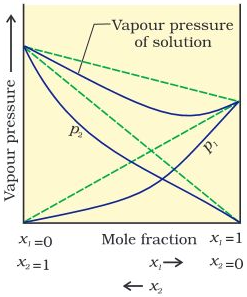
The graph given below indicates which of the following phenomena/ examples:

Figure

(A) Positive deviation from Raoult's law.

(B) Negative deviation from Raoult's law.

(C) Chloroform and acetone.

(D) Phenol and aniline.

Answer options

Q16:

2026: 15 May Shift 1

Solutions

Easy

A carboxylic acid (RCOOH) undergoes 88% dimerization in benzene. What will be the value of van't Hoff factor?

Answer options

Q17:

2026: 15 May Shift 1

Solutions

Medium

Match the LIST-I with LIST-II.

LIST-ILIST-II
A.AnoxiaI.Non-ideal solution with negative deviation.
B.Cellulose acetateII.Henry's Law
C.Ethanol and acetone solutionIII.Reverse Osmosis
D.Phenol and aniline solutionIV.Non-ideal solution with positive deviation.
Answer options

Q18:

2026: 15 May Shift 1

Solutions

Medium

Based on solute-solvent interactions, arrange the following in order of increasing solubility in n-octane.

A. Cyclohexane

B. Potassium chloride

C. Methanol

D. Acetonitrile

Answer options

Q19:

2026: 15 May Shift 1

Solutions

Medium

Vapour pressure of water at 293 K is 17.535 mm Hg. The vapour pressure of solution after adding 8.28 g of urea in 450 g of water will be

Given: Molar mass of urea is 60 g mol−1\mathrm{mol^{-1}} and assume the solution to be dilute.

Answer options

Q20:

2026: 15 May Shift 1

Solutions

Medium

Which of the following statements are correct in regard to non-ideal binary solution (X) showing negative deviations from Raoult's law?

A. The vapour pressure of X is lower than that predicted by Raoult’s law.

B. A mixture of chloroform and acetone forms a solution with negative deviation from Raoult’s law.

C. The intermolecular attractive forces between A-A and B-B are weaker than those between A-B.

D. (ΔV)mixing=0(\Delta V)_{\text{mixing}} = 0

Answer options

Q21:

2026: 14 May Shift 2

Solutions

Medium

Match the LIST-I with LIST-II.

LIST-I (Salt/ Complex in aqueous solution)LIST-II (van't Hoff Factor)
A.K2[HgI4]K_2[HgI_4]I.7
B.Fe4[Fe(CN)6]3Fe_4[Fe(CN)_6]_3II.5
C.Mg3(PO4)2Mg_3(PO_4)_2III.3
D.Na3PO4Na_3PO_4IV.4
Answer options

Q22:

2026: 14 May Shift 2

Solutions

Medium

20 g of a non-volatile and non-electrolytic solute dissolved in 100 g of water produces the relative lowering of vapor pressure of 0.1. The molar mass of solute in g mol−1mol^{-1} is:

Assume n2<<n1n_2 << n_1

Answer options

Q23:

2026: 14 May Shift 2

Solutions

Easy

The mole fraction of urea (NH2CONH2NH_2CONH_2) in an aqueous solution containing 36% of urea by mass is

Answer options

Q24:

2026: 14 May Shift 2

Solutions

Medium

A mixture of two volatile liquids A and B has a vapor pressure of 350 mm Hg at 300 K. The vapor pressure of B is 150 mm Hg. If the mole fraction of A is 0.4, its vapor pressure at same temperature will be:

Answer options

Q25:

2026: 14 May Shift 2

Solutions

Medium

Arrange the following aqueous solutions in increasing order of their boiling points.

Given: Molar mass (in g mol−1mol^{-1}) of H, C, N, O, S and K are 1, 12, 14, 16, 32 and 39, respectively.

A. 5% K2SO4K_2SO_4

B. 10 % Urea

C. 5% Urea

D. 10% K2SO4K_2SO_4

Answer options

Q26:

2026: 12 May Shift 2

Solutions

Medium

Which of the following cause and facts are true about positive deviations from ideal behavior of solutions?

(A) A-B interactions are weaker than those between A-A and B-B

(B) CS2_2 - Acetone solution shows positive deviation.

(C) Minimum boiling azeotrope is observed in positive deviation,

(D) Maximum boiling azeotrope is observed in positive deviation

Answer options

Q27:

2026: 12 May Shift 2

Solutions

Easy

Which way of expressing concentration is commonly used in industrial chemical applications?

Answer options

Q28:

2026: 12 May Shift 2

Solutions

Medium

0.02 g of the following substances (assuming non-electrolytes) are dissolved in 500 mL of water. Arrange them in increasing order of their elevation of boiling point of solution.

Given: Molar mass of H, C, N, O and Cl are 1, 12, 14, 16 and 35.5 g mol−1^{-1} respectively.

(A) C6H12O6\mathrm{C_6H_{12}O_6}

(B) NH2CONH2\mathrm{NH_2CONH_2}

(C) C12H22O11\mathrm{C_{12}H_{22}O_{11}}

(D) C3H7Cl\mathrm{C_3H_7Cl}

Answer options

Q30:

2026: 12 May Shift 2

Solutions

Easy

Match List-I with List-II

List-IList-II
(Constants)(Used directly in the expressions of)
(A) Ebullioscopic constant(I) Depression in freezing point.
(B) Henry's Law constant(II) Osmotic pressure.
(C) Cryoscopic constant(III) Elevation in boiling point.
(D) Gas constant(IV) The solubility of gas
Answer options