Q1:

2026: 29 May Shift 1

Solutions

Medium

Solutions

Let us consider a binary solution of two volatile liquids and denote the two components as 1 and 2. When taken in a closed vessel, both the components would evaporate and eventually an equilibrium would be established between vapour phase and the liquid phase. Let the total vapour pressure at this stage be ptotalp_{total} and p1p_1 and p2p_2 be the partial vapour pressures of the two components 1 and 2 respectively. These partial pressures are related to the mole fractions x1x_1 and x2x_2 of the two components 1 and 2 respectively. The French chemist, Francois Marte Raoult (1886) gave the quantitative relationship between them. The relationship is known as the Raoult's law which states that for a solution of volatile liquids the partial vapour pressure of each component of the solution is directly proportional to its mole fraction (x1x_1) present in solution.

On mixing, benzene and toluene form an ideal solution. At 88 °C, the vapour pressure of the two liquid components (benzene and toluene) are 957 mm Hg and 379.5 mm Hg respectively. The vapour pressure of the solution obtained by mixing 19.5 g of benzene and 46 g of toluene will be approximately: (molar mass of benzene = 78 g mol−1^{-1} and toluene = 92 g mol−1^{-1})

Answer options
Option 1
Correct Answer
Explanation for 2026: 29 May Shift 1 CHE question 1

Q2:

2026: 29 May Shift 1

Solutions

Easy

Solutions

Let us consider a binary solution of two volatile liquids and denote the two components as 1 and 2. When taken in a closed vessel, both the components would evaporate and eventually an equilibrium would be established between vapour phase and the liquid phase. Let the total vapour pressure at this stage be ptotalp_{total} and p1p_1 and p2p_2 be the partial vapour pressures of the two components 1 and 2 respectively. These partial pressures are related to the mole fractions x1x_1 and x2x_2 of the two components 1 and 2 respectively. The French chemist, Francois Marte Raoult (1886) gave the quantitative relationship between them. The relationship is known as the Raoult's law which states that for a solution of volatile liquids the partial vapour pressure of each component of the solution is directly proportional to its mole fraction (x1x_1) present in solution.

The change in enthalpy of mixing and the volume of mixing for the ideal solution which obeys Raoult's law will be

Answer options
Option 3
Correct Answer
Explanation for 2026: 29 May Shift 1 CHE question 2

Q3:

2026: 29 May Shift 1

Solutions

Medium

Solutions

Let us consider a binary solution of two volatile liquids and denote the two components as 1 and 2. When taken in a closed vessel, both the components would evaporate and eventually an equilibrium would be established between vapour phase and the liquid phase. Let the total vapour pressure at this stage be ptotalp_{total} and p1p_1 and p2p_2 be the partial vapour pressures of the two components 1 and 2 respectively. These partial pressures are related to the mole fractions x1x_1 and x2x_2 of the two components 1 and 2 respectively. The French chemist, Francois Marte Raoult (1886) gave the quantitative relationship between them. The relationship is known as the Raoult's law which states that for a solution of volatile liquids the partial vapour pressure of each component of the solution is directly proportional to its mole fraction (x1x_1) present in solution.

At constant temperature, 250 mL of nitrogen under 720 mm pressure and 380 mL of oxygen under 650 mm pressure were put into a one liter flask. The final pressure of the mixture will be;

Answer options
Option 1
Correct Answer
Explanation for 2026: 29 May Shift 1 CHE question 3

Q4:

2026: 29 May Shift 1

Solutions

Easy

Solutions

Let us consider a binary solution of two volatile liquids and denote the two components as 1 and 2. When taken in a closed vessel, both the components would evaporate and eventually an equilibrium would be established between vapour phase and the liquid phase. Let the total vapour pressure at this stage be ptotalp_{total} and p1p_1 and p2p_2 be the partial vapour pressures of the two components 1 and 2 respectively. These partial pressures are related to the mole fractions x1x_1 and x2x_2 of the two components 1 and 2 respectively. The French chemist, Francois Marte Raoult (1886) gave the quantitative relationship between them. The relationship is known as the Raoult's law which states that for a solution of volatile liquids the partial vapour pressure of each component of the solution is directly proportional to its mole fraction (x1x_1) present in solution.

When phenol and aniline are mixed, their boiling points become greater than both of them. The mixture is :

Answer options
Option 2
Correct Answer
Explanation for 2026: 29 May Shift 1 CHE question 4

Q5:

2026: 29 May Shift 1

Solutions

Medium

Solutions

Let us consider a binary solution of two volatile liquids and denote the two components as 1 and 2. When taken in a closed vessel, both the components would evaporate and eventually an equilibrium would be established between vapour phase and the liquid phase. Let the total vapour pressure at this stage be ptotalp_{total} and p1p_1 and p2p_2 be the partial vapour pressures of the two components 1 and 2 respectively. These partial pressures are related to the mole fractions x1x_1 and x2x_2 of the two components 1 and 2 respectively. The French chemist, Francois Marte Raoult (1886) gave the quantitative relationship between them. The relationship is known as the Raoult's law which states that for a solution of volatile liquids the partial vapour pressure of each component of the solution is directly proportional to its mole fraction (x1x_1) present in solution.

The vapour pressure of pure liquids P and R are 957 and 379.5 mm Hg, respectively at 350 K. The composition of the P and R mixture if total vapour pressure is 760 mm Hg will be

Answer options
Option 1
Correct Answer
Explanation for 2026: 29 May Shift 1 CHE question 5

Q6:

2026: 26 May Shift 2

Solutions

Medium

If a 500 mL solution contains 2 g of protein at 400 K has an osmotic pressure of 1.66×10−31.66 \times 10^{-3} bar. What is the molar mass of the protein ?

Answer options
Option 1
Correct Answer
Explanation for 2026: 26 May Shift 2 CHE question 6

Q7:

2026: 26 May Shift 2

Solutions

Medium

Which of the following solutions will exhibit the same elevation in their boiling points?

A. 0.03 M NaCl solution

B. 0.06 M Glucose solution

C. 0.01 M Aluminum Sulfate Solution

D. 0.02 M Calcium Chloride Solution

Answer options
Option 2
Correct Answer
Explanation for 2026: 26 May Shift 2 CHE question 7

Q8:

2026: 26 May Shift 2

Solutions

Hard

Arrange the following aqueous solutions in increasing order of their boiling points.

Given: Molar mass (in g mol−1^{-1}) of H, C, N, O, S and K respectively are 1, 12, 14, 16, 32 and 39.

A. 5% K2_2SO4_4

B. 10 % Urea

C. 5% Urea

D. 10% K2_2SO4_4

Answer options
Option 2
Correct Answer
Explanation for 2026: 26 May Shift 2 CHE question 8

Q10:

2026: 26 May Shift 2

Solutions

Easy

Among the following, the correct option is

Answer options

Q11:

2026: 26 May Shift 1

Solutions

Easy

Which of the following statements are true for ideal solutions?

(A) The solutions obey Raoult's law over the entire range of concentration.

(B) The change in entropy of mixing of the pure components to form the solution is zero.

(C) The change in volume of mixing of the pure components to form the solution is zero.

(D) The solutions obey Raoult's law only in low concentrations.

Answer options

Q12:

2026: 26 May Shift 1

Solutions

Medium

Calculate the vapour pressure (mm Hg) of the solution formed by mixing 25.5 g of A and 40.0 g of B at 298 K. The vapour pressure of A and B at 298 K are 200 mm Hg and 415 mm Hg, respectively. (Given: Molar mass of A =119.5 g/mol and B are 85.0 g/mol)

Answer options

Q13:

2026: 26 May Shift 1

Solutions

Medium

The value of Henry's Law constant KHK_H(in kbar) for He, H2_2, N2_2 and O2_2 in water at a pressure of 10 atm and temperature 293 K are 144.97, 69.16, 76.48 and 34.86, respectively. Arrange the gases in decreasing order of their solubility.

(A) He

(B) H2_2

(C) N2_2

(D) O2_2

Answer options

Q14:

2026: 26 May Shift 1

Solutions

Medium

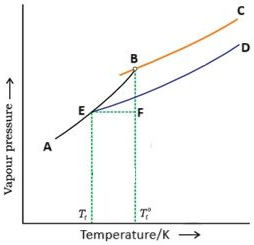
Match the various curves from List-I with the type of solutions/change in List-II with reference to the given figure..

Figure

CurveSolution/Change
(A) A-B(I) Liquid solvent
(B) B-C(II) Solution
(C) E-D(III) Depression in freezing point of solvent in solution
(D) E-F(IV) Frozen solvent
Answer options

Q15:

2026: 26 May Shift 1

Solutions

Medium

Arrange 0.1 M aqueous solution of the following in decreasing order of their osmotic pressure

(A) Ammonium phosphate

(B) Glucose

(C) Sodium chloride

(D) Potassium sulphate

Answer options

Q17:

2026: 25 May Shift 2

Solutions

Medium

Arrange the given aqueous solutions in increasing order of their boiling points:

(A) NH2CONH2NH_2CONH_2 (0.1m)

(B) AlCl3AlCl_3 (0.1m)

(C) Na2SO4Na_2SO_4 (0.1m)

(D) KCl (0.1m)

Answer options

Q18:

2026: 25 May Shift 2

Solutions

Medium

The conditions for ideal solutions are:

(A) Change in enthalpy of mixing is zero.

(B) Change in entropy of mixing is zero.

(C) Change in volume of mixing is zero.

(D) Internal energy change of mixing is zero.

Answer options

Q19:

2026: 25 May Shift 2

Solutions

Easy

Match List-I with List-II

List-IList-II
Solution formed by mixingExample
(A) Solid solute in gas solvent(I) Acetone in water.
(B) Liquid solute in liquid solvent(II) Hydrogen in palladium.
(C) Solid solute in solid solvent(III) Camphor in nitrogen gas.
(D) Gas solute in solid solvent(IV) Copper in gold.
Answer options

Q20:

2026: 25 May Shift 2

Solutions

Medium

The mole fraction of ethylene glycol (C2H6O2C_2H_6O_2) in aqueous solution containing 20% of C2H6O2C_2H_6O_2 by mass is

Answer options

Q21:

2026: 25 May Shift 1

Solutions

Medium

ppm is

Answer options

Q23:

2026: 25 May Shift 1

Solutions

Easy

The solubility of a solid in a liquid is significantly affected by temperature changes. This can be explained using the

Answer options

Q24:

2026: 25 May Shift 1

Solutions

Easy

Which of the following are gaseous solutions?

A. Chloroform mixed with N2\mathrm{N_2} gas

B. Camphor in N2\mathrm{N_2} gas

C. Hydrogen in Palladium

D. Oxygen in water

Answer options

Q25:

2026: 25 May Shift 1

Solutions

Easy

Match the LIST-I with LIST-II.

LIST-I Concentration termsLIST-II Units
A.MolarityI.mol kg−1\mathrm{mol\ kg^{-1}}
B.Mole FractionII.mol L−1\mathrm{mol\ L^{-1}}
C.MoleIII.unitless
D.MolalityIV.mol
Answer options

Q26:

2026: 24 May Shift 1

Solutions

Easy

Match List-I with List-II

List-IList-II
(A) Osmotic pressure(I) Formation of bubbles of nitrogen in the blood
(B) Anoxia(II) Pressure applied on the solution side that just stops the flow of solvent
(C) Bends(III) Impermeable to impurities
(D) Cellulose acetate(IV) Low blood oxygen causes climbers to become weak
Answer options

Q27:

2026: 24 May Shift 1

Solutions

Easy

Which of the following statements are true for the elevation of boiling point?

(A) The boiling point of a solution is always higher than the boiling point of the pure solvent in which the solution is prepared.

(B) The boiling point of a solution is always lower than the boiling point of the pure solvent in which the solution is prepared.

(C) The elevation of boiling point is directly proportional to the molal concentration of the solute in solution.

(D) Unit of KbK_b = K kg mol−1K\ kg\ mol^{-1}

Answer options

Q28:

2026: 24 May Shift 1

Solutions

Medium

Which of the following salts would have the same value of the van't Hoff factor as that of Al(NO3)3Al(NO_3)_3 in aqueous solution?

Assume complete dissociation of electrolytes.

(A) K2SO4K_2SO_4

(B) KCl

(C)Al2(SO4)3Al_2(SO_4)_3

(D) K3[Fe(CN)6]K_3[Fe(CN)_6]

Answer options

Q29:

2026: 24 May Shift 1

Solutions

Medium

Match List-I with List-II

List-IList-II
Type of solutionExample
(A) Ideal solution(I) 95% by volume of ethanol
(B) Positive deviation from Raoult's law(II) Bromoethane and chloroethane
(C) Negative deviation from Raoult's law(III) Ethanol and acetone
(D) Azeotrope(IV) Phenol and aniline
Answer options

Q30:

2026: 24 May Shift 1

Solutions

Easy

Water movement from soil into plant roots and subsequently into upper portion of the plant is partly due to phenomenon of

Answer options