Q1:
2025: 24 May Shift 2
Chemistry
d & f Block Elements
Easy
Calculate the magnetic moment of a divalent ion in aqueous solution if its atomic number is 27.
Correct Answer
Option 4
Correct Answer

2025: 24 May Shift 2
Chemistry
d & f Block Elements
Easy
Calculate the magnetic moment of a divalent ion in aqueous solution if its atomic number is 27.
2025: 23 May Shift 2
Chemistry
d & f Block Elements
Medium
Which one of these tripositive ions is the most stable in aqueous solution?
2025: 23 May Shift 2
Chemistry
d & f Block Elements
Easy
dissolves in aqueous NaOH to give:
2025: 23 May Shift 2
Chemistry
d & f Block Elements
Easy
Decide which of the following atomic numbers are the atomic numbers of the inner transition elements
(A) 59
(B) 95
(C) 102
(D) 74
2025: 23 May Shift 2
Chemistry
d & f Block Elements
Hard
Match the properties given in list-I with the metals given in list-II
| List-I | List-II |
|---|---|
| Property | Metal |
| (A) Element with highest second ionization enthalpy | (I) Co |
| (B) Element with highest heat of atomisation | (II) Cu |
| (C) M in | (III) Zn |
| (D) Element with highest third ionization enthalpy | (IV) Cr |
2025: 23 May Shift 2
Chemistry
d & f Block Elements
Medium
What are the products of the following reaction in neutral solution?
2025: 22 May Shift 1
Chemistry
d & f Block Elements
Easy
Calculated value of magnetic moment (BM) of an aqueous solution of is.........
2025: 22 May Shift 1
Chemistry
d & f Block Elements
Easy
Match the catalysts given in List-I with the process catalyzed by them given in List-II
| List-I | List-II |
|---|---|
| Catalyst | Process |
| (A) Ni in presence of Hydrogen | (I) Ziegler Natta Catalyst |
| (B) Finely divided iron | (II) Vegetable oil to ghee |
| (C) | (III) Sandmeyer reaction |
| (D) | (IV) Haber's process |
2025: 22 May Shift 1
Chemistry
d & f Block Elements
Easy
Predict which of the following will be colored in its aqueous solution?
2025: 22 May Shift 1
Chemistry
d & f Block Elements
Hard
Arrange the following oxidation states in increasing order
(A) characteristic oxidation state of lanthanoids
(B) most stable oxidation state of Mn in its oxides
(C) most stable oxidation state of Mn
(D) oxidation state of Mn in
2025: 22 May Shift 1
Chemistry
d & f Block Elements
Easy
Consider the following statements about the physical and chemical characteristics of interstitial compounds and identify the correct statements
(A) They have high melting points.
(B) They are very hard.
(C) They retain metallic conductivity.
(D) They are chemically very reactive.
2025: 22 May Shift 1
Chemistry
d & f Block Elements
Medium
Match the elements given in List-I with electronic configuration given in List-II
| List-I | List-II |
|---|---|
| Element | Electronic configuration |
| (A) Cerium | (I) |
| (B) Erbium | (II) |
| (C) Uranium | (III) |
| (D) Curium | (IV) |
2025: 21 May Shift 2
Chemistry
d & f Block Elements
Easy
2025: 21 May Shift 2
Chemistry
d & f Block Elements
Easy
2025: 21 May Shift 2
Chemistry
d & f Block Elements
Medium
2025: 21 May Shift 2
Chemistry
d & f Block Elements
Medium
2025: 21 May Shift 2
Chemistry
d & f Block Elements
Easy
2025: 21 May Shift 1
Chemistry
d & f Block Elements
Easy
Correct electronic configuration of Cu and Cr are__________
2025: 21 May Shift 1
Chemistry
d & f Block Elements
Medium
Select the correct statements from the following:
(A) Mn show the highest oxidation state in first transition series elements.
(B) Titanium (II) is more stable than titanium (III) and titanium (IV).
(C) Scandium does not exhibit variable oxidation states.
(D) Zn form complexes with only (II) oxidation state.
2025: 21 May Shift 1
Chemistry
d & f Block Elements
Medium
Considering the following statements; identify the correct statements:
(A) Scandium is regarded as a transition element, but zinc is not.
(B) is amphoteric and is basic oxide.
(C) The similar radii of Zr and Hf is a consequence of the lanthanoid contraction.
(D) The oxidation state of chromium in chromate and dichromate ion is same.
2025: 21 May Shift 1
Chemistry
d & f Block Elements
Medium
Choose the incorrect statement from the following:
2025: 21 May Shift 1
Chemistry
d & f Block Elements
Easy
Which of the following is used as a catalyst in contact process?
2025: 19 May Shift 2
Chemistry
d & f Block Elements
Easy
The products for the reaction of KMnO with potassium iodide in acidic solutions are
2025: 19 May Shift 2
Chemistry
d & f Block Elements
Medium
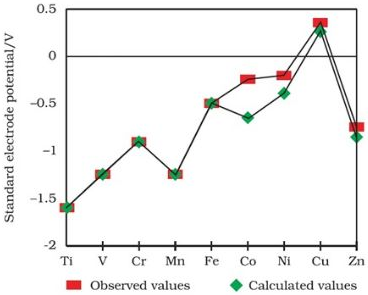
Observed and calculated values for the standard electrode potentials (M M) are shown in the figure above. Based on the data shown, which of the following statements are true?
(A) Cu is not able to liberate H from acid.
(B) Zn is not able to liberate H from acid.
(C) An increase in the sum of the first and second ionization enthalpies leads to less negative E° values.
(D) Only oxidising acids react with Cu
2025: 19 May Shift 2
Chemistry
d & f Block Elements
Easy
Which of the following metal ions does not show color in aqueous medium?
2025: 19 May Shift 2
Chemistry
d & f Block Elements
Easy
Lanthanoids (Ln) when heated with S, generally give.........
2025: 19 May Shift 2
Chemistry
d & f Block Elements
Easy
Which compound of transition metal is used as a catalyst in the Contact Process?
2025: 16 May Shift 1
Chemistry
d & f Block Elements
Easy
On what basis scandium is a considered as transition metal, but Zinc is not considered as transition metal?
2025: 16 May Shift 1
Chemistry
d & f Block Elements
Medium
The correct 4f sub-shell electronic configuration of Yb ion is
2025: 16 May Shift 1
Chemistry
d & f Block Elements
Medium
Out of the following given statements, identify the correct ones:
(A) Yttrium does not exhibit variable oxidation states, yet it is a transition element.
(B) Many compounds of transition elements act as catalysts in various chemical reactions.
(C) Technetium is an artificially synthesized element of 4d transition series.
(D) The E value for the Mn/Mn couple is much more positive than that for Cr/Cr.