Q1:
2025: 28 May Shift 1
Physics
Ray Optics & Optical Instruments
Medium
For a given convex lens, if the object distance is:
(A)
(B)
(C)
(D)
The distance of the image is arranged in decreasing order:
Correct Answer
Option 4
Correct Answer

2025: 28 May Shift 1
Physics
Ray Optics & Optical Instruments
Medium
For a given convex lens, if the object distance is:
(A)
(B)
(C)
(D)
The distance of the image is arranged in decreasing order:
2025: 28 May Shift 1
Physics
Ray Optics & Optical Instruments
Easy
A printed page is kept pressed by a glass cube (=1.5) of 5 cm edge. By what amount will the printed letters appear to be shifted when viewed from the top?
2025: 28 May Shift 1
Physics
Ray Optics & Optical Instruments
Medium
The lateral shift produced by a glass slab during refraction through it, increases with -
(A) the increase in the thickness of the glass slab
(B) the increase in the value of the angle of incidence
(C) the increase in the value of the refractive index of the slab
(D) the increase in the length of the glass slab
2025: 28 May Shift 1
Physics
Ray Optics & Optical Instruments
Medium
The two possible positions of an object kept in front of a lens of power +5.0 D, so that the image formed in both cases is four times magnified, are
(A) -30 cm
(B) -25 cm
(C) -15 cm
(D) -45 cm
2025: 27 May Shift 2
Physics
Ray Optics & Optical Instruments
Easy
Match List-I with List-II( here symbols have their usual meanings)
| List-I | List-II |
|---|---|
| (Physical Quantity / Law) | (Formula) |
| (A) Snell's law | (I) |
| (B) Apparent Shift | (II) |
| (C) Refractive Index | (III) |
| (D) Apparent depth | (IV) |
2025: 27 May Shift 2
Physics
Ray Optics & Optical Instruments
Easy
The refractive indices of glass and water are 3/2 and 4/3, respectively. If the speed of light in water is m/s, the speed of light in glass will be
2025: 27 May Shift 2
Physics
Ray Optics & Optical Instruments
Easy
The magnification (m) and focal length (f) of a plane mirror are
2025: 27 May Shift 2
Physics
Ray Optics & Optical Instruments
Easy
At sunrise and sunset the sun appears reddish due to
2025: 27 May Shift 2
Physics
Ray Optics & Optical Instruments
Easy
An object is placed at 5 cm in front of a concave mirror with a radius of curvature of 20 cm. The distance of the image from mirror and its nature are
2025: 26 May Shift 2
Physics
Ray Optics & Optical Instruments
Medium
To find the focal length of a convex lens, a student obtains the real, inverted and magnified image on the screen as shown in the figure below
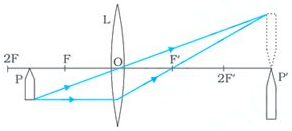
Now the whole set up is immersed in water without disturbing the object and position of the screen. What will be student's observation on the screen?
2025: 26 May Shift 2
Physics
Ray Optics & Optical Instruments
Easy
Which of the following is not based on total internal reflection?
2025: 26 May Shift 2
Physics
Ray Optics & Optical Instruments
Medium
A diverging lens of glass ( = 1.5) has both surfaces of the same radius of curvature (R). On immersion in a medium of refractive index ( = 1.8), it will behave as
2025: 26 May Shift 2
Physics
Ray Optics & Optical Instruments
Easy
The magnifying power of a telescope is 6 in normal adjustment. The distance between its two lenses is 35 cm. The focal lengths of objective and eye-piece are, respectively:
2025: 23 May Shift 2
Physics
Ray Optics & Optical Instruments
Medium
The critical angle is maximum when light travels from
2025: 23 May Shift 2
Physics
Ray Optics & Optical Instruments
Easy
A telescope has an objective lens of focal length 150 cm and an eyepiece of focal length 5.0 cm. The magnifying power of the telescope is
2025: 22 May Shift 1
Physics
Ray Optics & Optical Instruments
Easy
A biconvex lens has radii of curvature of 10 cm each. If the refractive index of the material of the lens is1.5, what will be its focal length in air ?
2025: 22 May Shift 1
Physics
Ray Optics & Optical Instruments
Easy
The extraordinary sparkling of an appropriately cut diamond is due to
2025: 22 May Shift 1
Physics
Ray Optics & Optical Instruments
Hard
Rohit has been given two converging lenses of focal lengths 1.25 cm and 5 cm, respectively to design a compound microscope. If it is desired to have a magnification of 30, what would be the separation between the objective and the eyepiece when the final image is formed at the least distance of distinct vision?
2025: 22 May Shift 1
Physics
Ray Optics & Optical Instruments
Easy
When a convex lens of glass is immersed in water, its power will
2025: 22 May Shift 1
Physics
Ray Optics & Optical Instruments
Medium
Which of the following statements are true for the minimum deviation position of a prism?
(A). The angle of the prism is twice the angle of refraction.
(B). The refracted ray is parallel to the base of prism.
(C). The angle of incidence is equal to the angle of emergence.
(D). The angle of deviation is half the angle of a prism.
2025: 21 May Shift 2
Physics
Ray Optics & Optical Instruments
Easy
The necessary conditions for total internal reflection are
(A) Light must travel from denser to rarer medium.
(B) The angle of incidence in the denser medium must be less than the critical angle for the two media.
(C) Light must travel from rarer to denser medium.
(D)The angle of incidence in the denser medium must be greater than the critical angle for the two media.
2025: 21 May Shift 2
Physics
Ray Optics & Optical Instruments
Medium
Arrange the following steps (A, B, C and D) in proper sequence to determine the index correction in the given arrangement.
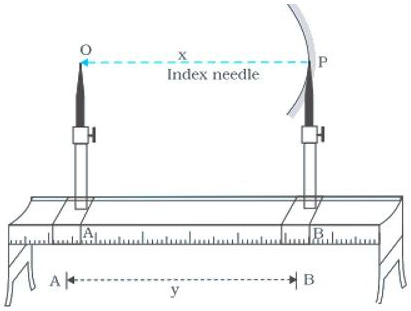
(A) The difference between the two gives the correction to be applied to the observed distance.
(B) The positions of the uprights are read on the scale. Their difference gives the observed distance between tip of the pin and the pole of the mirror.
(C) A thin straight index needle OP is placed so that its one end O touches the tip of the pin and the other end P touches the pole of the mirror.
(D) Length of the needle OP is measured by placing it on the scale which is the actual distance between the points in question.
2025: 21 May Shift 2
Physics
Ray Optics & Optical Instruments
Easy
A planoconvex lens has the radius of curvature of its curved surface 50 cm and the refractive index of its material is 1.5. Its focal length will be
2025: 21 May Shift 2
Physics
Ray Optics & Optical Instruments
Easy
For which pair among the following, the refractive index will have the minimum and maximum value, respectively ?
2025: 21 May Shift 1
Physics
Ray Optics & Optical Instruments
Easy
The colour of light which is scattered the most by atmospheric molecules is
2025: 21 May Shift 1
Physics
Ray Optics & Optical Instruments
Medium
A convex lens has 20 cm focal length in air. Its focal length in water would be
(Given : Refractive index of water = 1.33, refractive index for glass = 1.5)
2025: 21 May Shift 1
Physics
Ray Optics & Optical Instruments
Easy
A point source of light is placed at a distance twice the focal length of a converging lens. If the focal length of the lens is , the intensity of the image of light source on the other side of the lens will be maximum at
2025: 21 May Shift 1
Physics
Ray Optics & Optical Instruments
Easy
A thin lens of focal length 20 cm placed in combination with another thin lens acts as a lens of focal length 12.5 cm. The power of is
2025: 20 May Shift 2
Physics
Ray Optics & Optical Instruments
Easy
The radii of curvature of the two surfaces of a concave lens are 20 cm each. The refractive index of the material of the lens is 1.5. The power of the lens would be-
2025: 20 May Shift 2
Physics
Ray Optics & Optical Instruments
Easy
An eye specialist prescribes spectacles having a combination of a converging lens of focal length 25 cm and a diverging lens of focal length of 20 cm. The power of the combination of two lenses (in dioptre) is