CUET Physics: PhysicsRay Optics & Optical Instruments. Free, no login required.

Q1:

2025: 2 June Shift 2

Ray Optics & Optical Instruments

Medium

A ray of light from air passes through an equilateral triangular glass prism and undergoes minimum deviation when the angle of incidence is 34\frac{3}{4} of the angle of the prism. The speed of light in prism is

Answer options
Option 2
Correct Answer
Explanation for 2025: 2 June Shift 2 PHY question 1

Q2:

2025: 2 June Shift 2

Ray Optics & Optical Instruments

Easy

When white light consisting of wavelengths ranging from 400 nm to 700 nm passes through water (μ\mu = 4/3), then the wavelength range in water will be:

Answer options
Option 1
Correct Answer
Explanation for 2025: 2 June Shift 2 PHY question 2

Q3:

2025: 2 June Shift 2

Ray Optics & Optical Instruments

Easy

A symmetrical double convex lens is cut into two equal parts by a plane containing the principal axis:

The power of the divided lens is:

Answer options
Option 2
Correct Answer
Explanation for 2025: 2 June Shift 2 PHY question 3

Q4:

2025: 2 June Shift 2

Ray Optics & Optical Instruments

Easy

The magnifying power of a compound microscope is high, if

Answer options
Option 3
Correct Answer
Explanation for 2025: 2 June Shift 2 PHY question 4

Q5:

2025: 2 June Shift 1

Ray Optics & Optical Instruments

Medium

A thin prism of refractive index 1.5 when placed in air deviates a light ray by a minimum angle of 5∘5^\circ. The angle of minimum deviation when it is immersed in oil of refractive index 1.25 is:

Answer options
Option 1
Correct Answer
Explanation for 2025: 2 June Shift 1 PHY question 5

Q6:

2025: 2 June Shift 1

Ray Optics & Optical Instruments

Hard

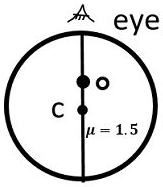
There is a small air bubble inside a glass sphere (μ=1.5)(\mu = 1.5) of radius 10 cm. The bubble is 4.0 cm below the surface and is viewed normally from outside as shown. The apparent depth of the bubble will be

Figure

Answer options
Option 3
Correct Answer
Explanation for 2025: 2 June Shift 1 PHY question 6

Q7:

2025: 2 June Shift 1

Ray Optics & Optical Instruments

Easy

When light passes from air to glass, then

Answer options
Option 2
Correct Answer
Explanation for 2025: 2 June Shift 1 PHY question 7

Q8:

2025: 2 June Shift 1

Ray Optics & Optical Instruments

Easy

Rainbow is a phenomenon due to the combined effect of

(A) Interference

(B) Dispersion

(C) Reflection

(D) Refraction

(E) Scattering

Answer options
Option 2
Correct Answer
Explanation for 2025: 2 June Shift 1 PHY question 8

Q9:

2025: 2 June Shift 1

Ray Optics & Optical Instruments

Medium

Identify the correct statement(s).

(A) In any lens, the optical centre is always at the centre of the lens.

(B) In a lens, if the curvature of its two surfaces is equal, the optical centre is at the centre of the lens.

(C) A light ray passing through the optical centre of a lens never shifts from the direction of the incident ray.

(D) A ray of light incident perpendicularly on a lens passes through its focus after refraction.

Answer options
Option 2,4
Correct Answer
Explanation for 2025: 2 June Shift 1 PHY question 9

Q10:

2025: 30 May Shift 2

Ray Optics & Optical Instruments

Medium

A thin convex lens of refractive index 1.5 has focal length f1f_1. When immersed in a liquid of refractive index 53\frac{5}{3}, its focal length is found to be f2f_2. The relationship between f1f_1 and f2f_2 is:

Answer options

Q11:

2025: 30 May Shift 2

Ray Optics & Optical Instruments

Medium

The distance between a luminous object and the screen is 60 cm. A convex lens placed in between produces a three times magnified image on the screen. The focal length of the convex lens is:

Answer options

Q12:

2025: 30 May Shift 2

Ray Optics & Optical Instruments

Easy

The refractive index of water is (43)\left(\frac{4}{3}\right) and that of glass is (32)\left(\frac{3}{2}\right). If the speed of light in glass is 2×1082 \times 10^8 m/s, the speed of light in water will be

Answer options

Q13:

2025: 30 May Shift 1

Ray Optics & Optical Instruments

Medium

The focal length of a convex lens in air and in a liquid medium are 20 cm and 80 cm, respectively. If the absolute refractive index of lens is 1.5, then the refractive index of liquid is:

Answer options

Q14:

2025: 30 May Shift 1

Ray Optics & Optical Instruments

Easy

Match List-I with List-II for convex lens (symbols have their usual meanings)

List-IList-II
Position of objectDetails of image
(A) at 2F(I) m > 1, virtual
(B) at F(II) m < 1, real
(C) between lens and F(III) m = 1, real
(D) between ∞\infty and 2F(IV) m > > 1, real
Answer options

Q15:

2025: 30 May Shift 1

Ray Optics & Optical Instruments

Medium

The light from a point source placed in air is incident on a convex spherical glass surface of radius of curvature 30 cm. The refractive index of the glass is 1.5. The distance of light source from the glass surface is 120 cm. The distance of the image formed from the glass surface is

Answer options

Q16:

2025: 30 May Shift 1

Ray Optics & Optical Instruments

Easy

Which of the following are true for optical instruments?

(A) A simple microscope is a converging lens of large focal length.

(B) A telescope is used to provide angular magnification of distant objects.

(C) The objective lens of a telescope has a smaller focal length than the eyepiece.

(D) The magnifying power of a telescope is the ratio of the focal length of the objective lens to the focal length of the eyepiece.

(E) A simple microscope is a converging lens of small focal length.

Answer options

Q17:

2025: 30 May Shift 1

Ray Optics & Optical Instruments

Medium

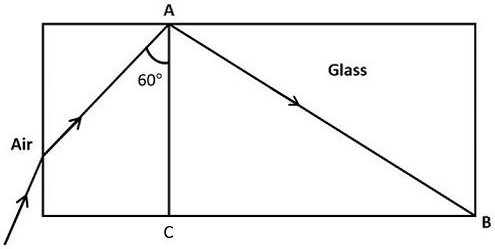
A light ray from air is incident on a glass slab (μ\mu = 1.5) as shown in the figure. It undergoes a total internal reflection and travels along AB. The thickness AC of the glass slab is 20 cm. The time taken by light to cross the glass slab after reflection is

Figure

Answer options

Q18:

2025: 29 May Shift 2

Ray Optics & Optical Instruments

Easy

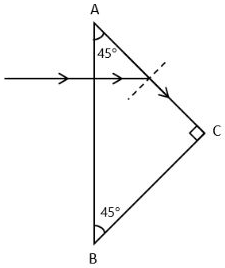
When a ray of light is incident on the face AB of prism normally, after refraction it is found to graze the side AC as shown in the figure, the refractive index of the prism is

Figure

Answer options

Q19:

2025: 29 May Shift 2

Ray Optics & Optical Instruments

Easy

Daily life phenomena based on scattering of light are

(A) Blue colour of sky

(B) Clouds appearing white

(C) Twinkling of stars

(D) Danger signals being red

Answer options

Q20:

2025: 29 May Shift 2

Ray Optics & Optical Instruments

Medium

Light from a point source in the air falls on a convex spherical glass surface having radius of curvature 20 cm and refractive index 1.5. The distance of the light source from the glass surface is 100 cm. The distance of the image from the glass surface is:

Answer options

Q21:

2025: 29 May Shift 2

Ray Optics & Optical Instruments

Medium

You are sitting in a parked car and you notice a boy running towards the car in the side view mirror of the car. If the boy is running at a constant speed towards you, which option according to you is correct

Answer options

Q22:

2025: 29 May Shift 1

Ray Optics & Optical Instruments

Medium

The distance between an object and its virtual image of magnification 12\frac{1}{2} as produced by a lens is 20 cm. The focal length of the lens is

Answer options

Q23:

2025: 29 May Shift 1

Ray Optics & Optical Instruments

Easy

The power of a biconvex lens is 12 D and the radius of curvature of each surface is 10 cm. The refractive index of the material of the lens is

Answer options

Q24:

2025: 29 May Shift 1

Ray Optics & Optical Instruments

Easy

If the value of the refractive index of a denser medium with respect to the rarer medium is 1.414, then the critical angle is:

Answer options

Q25:

2025: 29 May Shift 1

Ray Optics & Optical Instruments

Medium

Identify the correct statements.

(A) A concave mirror is preferred over a plane mirror for the purpose of shaving.

(B) The absolute refractive index of a medium can be less than unity.

(C) Snell's law gives the relative refractive index of a medium.

(D) When a convex lens is placed inside a transparent medium of refractive index greater than that of its own material, it behaves as a diverging lens.

Answer options

Q26:

2025: 28 May Shift 2

Ray Optics & Optical Instruments

Easy

The refractive indices of glass and water are 3/2 and 4/3, respectively. If light passes from glass to water, the critical angel is

Answer options

Q27:

2025: 28 May Shift 2

Ray Optics & Optical Instruments

Medium

The focal length of the objective of a compound microscope is fof_o and its distance from the eyepiece is L. An object is placed at a distance u from the objective. For proper working of the instrument

(A) L < u

(B) L > u

(C) fof_o < L < 2 fof_o

(D) L > 2 fof_o

Answer options

Q28:

2025: 28 May Shift 2

Ray Optics & Optical Instruments

Medium

A convex lens of focal length 40 cm is placed in contact with a concave lens of focal length 20 cm. If an object is placed at 40 cm in front of the combination, the position of the image formed by the combination is

Answer options

Q29:

2025: 28 May Shift 2

Ray Optics & Optical Instruments

Medium

A thin equiconvex lens of radius of curvature R made up of glass (μ\mu =1.5) is dipped in water (μ\mu = 1.3). Its focal length in water is

Answer options

Q30:

2025: 28 May Shift 1

Ray Optics & Optical Instruments

Easy

The phenomenon of spliting of white light into the constituent colours on passing through a prism is known as-

Answer options