
To find the focal length of a convex lens, a student obtains the real, inverted and magnified image on the screen as shown in the figure below
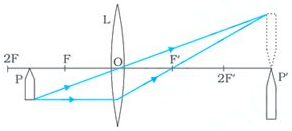
Now the whole set up is immersed in water without disturbing the object and position of the screen. What will be student's observation on the screen?
To find the focal length of a convex lens, a student obtains the real, inverted and magnified image on the screen as shown in the figure below
Now the whole set up is immersed in water without disturbing the object and position of the screen. What will be student's observation on the screen?
Solution
The focal length of a lens depends on the medium, through the lensmaker's formula .
Taking for glass and for water, the focal length in water is
So the focal length becomes about 4 times larger. In the figure the object lies between and of the lens in air, so its distance is less than . This is far less than the new focal length . The object is now inside the focal length, so the lens forms a virtual, erect image on the same side as the object. A virtual image cannot be caught on a screen, so the image disappears from the screen.
Option 4: the image would indeed be magnified, but it is virtual, so it cannot be seen on the screen.
Option 1: the focal length does change in water, so the image cannot stay the same.
Related questions:
2026: 31 May Shift 2
2025: 3 June Shift 1
2026: 21 May Shift 2