Q1:
2025: 2 June Shift 2
Physics
Dual Nature of Radiation & Matter
Easy
If h is the Planck's constant, then the momentum of the photon having frequency is represented by
Correct Answer
Option 2
Correct Answer

2025: 2 June Shift 2
Physics
Dual Nature of Radiation & Matter
Easy
If h is the Planck's constant, then the momentum of the photon having frequency is represented by
2025: 2 June Shift 1
Physics
Dual Nature of Radiation & Matter
Medium
The graphs of stopping potential versus frequency of incident radiation for two metals Ⓐ and Ⓑ are given.
Identify the correct statement(s) from the following
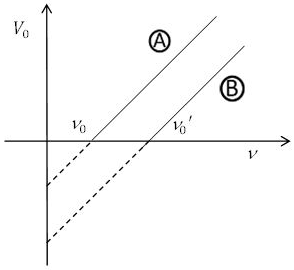
(A) The slope of the graphs is equal to the Planck's constant.
(B) Intercept on the (-y) axis is equal to (work function/e).
(C) Threshold frequency for metal Ⓐ is higher than metal Ⓑ
(D) Work function for metal Ⓑ is greater than metal Ⓐ
2025: 2 June Shift 1
Physics
Dual Nature of Radiation & Matter
Medium
When a radiation is incident on a metal surface of work function , photo electrons are emitted with some maximum kinetic energy (). If the frequency of the incident radiation is doubled, then the maximum kinetic energy of the emitted photo electrons will become
2025: 2 June Shift 1
Physics
Dual Nature of Radiation & Matter
Medium
A proton moves with a velocity equal to of velocity of light. The associated de-Broglie wavelength is:
2025: 30 May Shift 2
Physics
Dual Nature of Radiation & Matter
Easy
The stopping potential of photo-electrons depends upon:
2025: 30 May Shift 2
Physics
Dual Nature of Radiation & Matter
Easy
The wavelength of the de-Broglie wave associated with an electron accelerated through 150 V is:
2025: 30 May Shift 2
Physics
Dual Nature of Radiation & Matter
Medium
The number of photons emitted per minute by a 25 W source of monochromatic light of wavelength 6000 Å is approximately: (take Js)
2025: 30 May Shift 1
Physics
Dual Nature of Radiation & Matter
Easy
Identify the correct statements.
(A) The energy (E) and momentum (p) of a photon are related by p = E/c.
(B) The electrons and photons of the same wavelength, possess the same momentum.
(C) One photon having energy more than work function can emit one photo electron.
(D) Photons do not carry momentum.
2025: 30 May Shift 1
Physics
Dual Nature of Radiation & Matter
Medium
Light of frequency Hz is incident on a metal surface. Electrons with a maximum speed of m/s are ejected from the surface. The threshold frequency for photoemission of electrons will be
(Given: h= Js and mass of electron = kg)
2025: 30 May Shift 1
Physics
Dual Nature of Radiation & Matter
Easy
If the work function of the target material is 1.25 eV and the wavelength of the incident radiation is 2460 Å the stopping potential required to stop the emitted electrons is:
(Given: Js)
2025: 29 May Shift 2
Physics
Dual Nature of Radiation & Matter
Easy
When light of suitable frequency is incident on a photosensitive material, photo electrons are ejected and photoelectric current flows. If the intensity of the incident light is increased, then
2025: 29 May Shift 2
Physics
Dual Nature of Radiation & Matter
Medium
A proton has double the kinetic energy of an - particle. The ratio of the de-Broglie wavelength of the proton to that of - particle will be
2025: 29 May Shift 2
Physics
Dual Nature of Radiation & Matter
Easy
The energy of a photon of wavelength is
(Given: )
2025: 29 May Shift 1
Physics
Dual Nature of Radiation & Matter
Easy
If the two particles of the same mass and same charge are accelerated with a potential difference of 120 V and 480 V respectively, the ratio of de Broglie’s wavelengths associated with the two particles respectively is
2025: 29 May Shift 1
Physics
Dual Nature of Radiation & Matter
Easy
In experimental arrangement to study photoelectric effect, here M,N,O and P respectively are
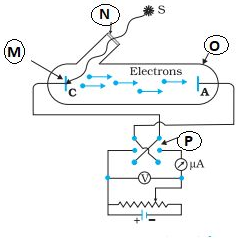
(A) Commutator
(B) Evacuated glass tube
(C) Quartz window
(D) Photosensitive plate
2025: 28 May Shift 2
Physics
Dual Nature of Radiation & Matter
Easy
A photon has a momentum of kg m/s. The frequency of the waves associated with the photon will be
(Given: h= Js)
2025: 28 May Shift 2
Physics
Dual Nature of Radiation & Matter
Medium
A proton is accelerated by a potential V and the de-Broglie wavelength associated with it is . By how much potential a deutron should be accelerated to acquire the same de-Broglie wavelength as that of a proton?
2025: 28 May Shift 2
Physics
Dual Nature of Radiation & Matter
Easy
The slope of the stopping potential versus frequency of the incident radiation plot is
(Where symbols have their usual meaning)
2025: 28 May Shift 1
Physics
Dual Nature of Radiation & Matter
Easy
Kinetic energies of four particles a,b,c,d of equal masses are given below. Arrange them in order of their decreasing de-Broglie wavelengths.
(A) = 1 eV
(B) = 0.01 eV
(C) = 4 eV
(D) = 16 eV
2025: 28 May Shift 1
Physics
Dual Nature of Radiation & Matter
Medium
A photosensitive surface is illuminated by a point source of light 1 m away. When the source is shifted to 2 m then
2025: 28 May Shift 1
Physics
Dual Nature of Radiation & Matter
Medium
The energy of a photon is equal to the kinetic energy of a proton. The energy of the photon is E. Let be the de-Broglie wavelength of the proton and be the wavelength of the photon. The ratio is proportional to the following
2025: 27 May Shift 2
Physics
Dual Nature of Radiation & Matter
Medium
Arrange the de-Broglie wavelengths associated with the following in the decreasing order:
(Given: J s)
(A) an electron (mass kg) in the hydrogen atom moving with the speed of m s
(B) a bullet (mass 0.04 kg) travelling at the speed of m s
(C) a ball (mass 0.06 kg) moving with the speed of 1.0 m s
(D) a dust particle (mass kg) drifting with the speed of 3.3 m s
2025: 27 May Shift 2
Physics
Dual Nature of Radiation & Matter
Medium
A proton and an alpha particle accelerated through different potential differences have the same de-Broglie wavelength. The ratio of their respective accelerating potentials is
2025: 27 May Shift 2
Physics
Dual Nature of Radiation & Matter
Easy
In the photoelectric effect, the stopping potential depends on the
2025: 26 May Shift 2
Physics
Dual Nature of Radiation & Matter
Easy
The energy of a photon of wavelength is
2025: 26 May Shift 2
Physics
Dual Nature of Radiation & Matter
Medium
A proton, an electron, a neutron and an alpha particle have the same energy. Their de Broglie's wavelengths are given below
(A)
(B)
(C)
(D)
Arrange these wavelengths in decreasing order.
2025: 26 May Shift 2
Physics
Dual Nature of Radiation & Matter
Easy
For a photosensitive surface, work function is J. Taking Planck's constant to be Js, the threshold frequency would be
2025: 23 May Shift 2
Physics
Dual Nature of Radiation & Matter
Easy
For a given photosensitive material, the stopping potential varies with the frequency of incident radiation as
2025: 23 May Shift 2
Physics
Dual Nature of Radiation & Matter
Medium
If light of wavelength 412.5 nm is incident on each of the metals given below, which ones will show photoelectric emission ?
| Metal | Work Function (eV) |
|---|---|
| Na | 1.92 |
| K | 2.15 |
| Ca | 3.20 |
| Mo | 4.17 |
2025: 23 May Shift 2
Physics
Dual Nature of Radiation & Matter
Easy
Ultraviolet radiations of 6.2 eV are incident on an aluminum surface of work function 4.2 eV. The maximum kinetic energy of the emitted electrons is