Q1:
2026: 19 May Shift 2
Physics
Dual Nature of Radiation & Matter
Easy
Identify the correct statement among the following.
Correct Answer
Option 2
Correct Answer

2026: 19 May Shift 2
Physics
Dual Nature of Radiation & Matter
Easy
Identify the correct statement among the following.
2026: 19 May Shift 2
Physics
Dual Nature of Radiation & Matter
Medium
Arrange the following particles in the ascending order of their de-Broglie wavlengths.
A. An electron moving with velocity 5
B. A proton moving with velocity 10
C. A neutron moving with velocity 20
D. An -particle moving with velocity 15
2026: 19 May Shift 2
Physics
Dual Nature of Radiation & Matter
Medium
The energy of a photon of wavelength is equal to
2026: 19 May Shift 1
Physics
Dual Nature of Radiation & Matter
Easy
If k be the kinetic energy and m is the mass of a moving particle, then the de-Brogle wavelength of the particle is
2026: 19 May Shift 1
Physics
Dual Nature of Radiation & Matter
Easy
The work function of a photoelectric surface is 3.3 eV. The threshold frequency for the surface is approximately
2026: 19 May Shift 1
Physics
Dual Nature of Radiation & Matter
Easy
The wave theory of light could not explain the phenomenon of
2026: 19 May Shift 1
Physics
Dual Nature of Radiation & Matter
Medium
Choose the correct statements among the following
(A) Photo electron emission from a photo-sensitive surface is possible only if the incident radiation has a frequency above the threshold frequency.
(B) The maximum kinetic energy of the photoelectrons in a photoelectric effect varies linearly with the intensity of incident radiation.
(C) An electron and a proton are accelerated through the same potential. The momentum associated with the electron is lesser as compared to the proton.
(D) An electron and a proton have the same de-Broglie wavelength. The proton has a higher kinetic energy than the electron.
2026: 18 May Shift 2
Physics
Dual Nature of Radiation & Matter
Easy
The longest wavelength of light that can cause emission of electrons from a photosensitive material of work function 2.2 eV will be
2026: 18 May Shift 2
Physics
Dual Nature of Radiation & Matter
Easy
Arrange the following steps for the photoelectric effect.
A. Electron emission takes place from the metal surface.
B. Absorption of energy from the incident radiation takes place.
C. Light falls on a metal surface.
D. Electrons near the surface gain enough energy to overcome the attraction of the positive ions in the metal surface.
2026: 18 May Shift 2
Physics
Dual Nature of Radiation & Matter
Medium
For a given photosensitive material and frequency of incident radiation,
A. above the threshold frequency, the photoelectric current is directly proportional to the intensity of the incident radiation.
B. the photoelectric emission process has observable time lag especially when the incident radiation is made exceedingly dim.
C. the stopping potential is independent of the intensity of the incident radiation.
D. below the threshold frequency, the emission of photo-electrons takes place instantly.
2026: 18 May Shift 1
Physics
Dual Nature of Radiation & Matter
Easy
The frequency of a photon whose energy is 66.3 eV is-
2026: 18 May Shift 1
Physics
Dual Nature of Radiation & Matter
Medium
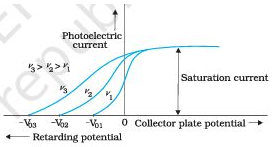
In the above figure the variation of photoelectric current with collector plate potential is given. Choose the correct statements.
(A) The saturation current is constant for different frequencies of incident radiations.
(B) The intensity of the incident radiations is same for different frequencies.
(C) The stopping potential increases with the increase in frequency of incident radiations.
(D) The saturation current increases with the frquency of radiation.
2026: 18 May Shift 1
Physics
Dual Nature of Radiation & Matter
Medium
Match List-I with List-II
| List-I | List-II |
|---|---|
| (Physical Quantity) | (Dimensions) |
| (A) Stopping Potential | (I) |
| (B) Work Function | (II) |
| (C) Planck's Constant | (III) |
| (D) Threshold Frequency | (IV) |
2026: 15 May Shift 1
Physics
Dual Nature of Radiation & Matter
Easy
The work function of a substance is 2.21 eV. Its threshold frequency will be approximately:
(Given, Js).
2026: 15 May Shift 1
Physics
Dual Nature of Radiation & Matter
Medium
The following particles have same kinetic energies. Arrange them in the descending order of their de-Broglie wavelengths.
A. -particle
B. -particle
C. Neutron
D. Proton
2026: 15 May Shift 1
Physics
Dual Nature of Radiation & Matter
Easy
When Ultra-violet (UV) radiations of intensity are incident an a given photocell, the maximum K.E of emitted photo electrons is . and stopping potential is . If the UV radiations are replaced by a blue light of same intensity (assuming that photoelectrons are emitted), then identify the correct statement(s) among the following:
A. will increase but will remain same
B. will remain same and will decrease
C. and both will decrease
D. will remain same and will decrease
2026: 14 May Shift 2
Physics
Dual Nature of Radiation & Matter
Easy
Match the LIST-I with LIST-II
| LIST-I (Physical quantity) | LIST-II (Units) | ||
|---|---|---|---|
| A. | Work function | I. | |
| B. | Planck's Constant | II. | Joule (J) |
| C. | Boltzmann Constant | III. | Joule-second (Js) |
| D. | Rydberg constant | IV. | Joule-Kelvin |
2026: 14 May Shift 2
Physics
Dual Nature of Radiation & Matter
Medium
Arrange the following particles having same kinetic energy in increasing order of their de-Broglie wavelengths.
A. Electron
B. Proton
C. Neutron
D. Alpha particle
2026: 14 May Shift 2
Physics
Dual Nature of Radiation & Matter
Easy
In the context of Einstein's photo-electric effect experiment, identify the correct statements among the following.
A. The energy of each photon is , where is the frequency
B. The work function is the minimum energy needed to remove an electron from the illuminated surface.
C. Kinetic energy of Photoelectrons depends on frequency of light, not on its intensity.
D. The threshold frequency depends on intensity of incident light.
2026: 12 May Shift 2
Physics
Dual Nature of Radiation & Matter
Medium
An electromagnetic wave of frequency Hz propagating in vacuum has a momentum of ________.
2026: 12 May Shift 2
Physics
Dual Nature of Radiation & Matter
Easy
In a photoelectric effect experiment, if the intensity of the incident light of frequency greater than the threshold frequency, is increased, then
2026: 12 May Shift 2
Physics
Dual Nature of Radiation & Matter
Easy
Arrange the following particles having same velocities in descending order of their de Broglie wavelengths.
(A) Deutron
(B) Proton
(C) Positron
(D) Helium nucleus
2025: 3 June Shift 2
Physics
Dual Nature of Radiation & Matter
Medium
There are four particles A, B, C and D with the same mass and equal kinetic energy K. If the kinetic energy of particle A becomes 4 K, B becomes 9 K, C becomes 64 K and D becomes 16 K times, respectively, the fractional change in the de Broglie wavelength of the particles arranged in increasing order is
2025: 3 June Shift 2
Physics
Dual Nature of Radiation & Matter
Easy
The momentum of a photon associated with a radiation of frequency Hz is
(Given: J s and m/s)
2025: 3 June Shift 2
Physics
Dual Nature of Radiation & Matter
Medium
Figure given below shows variation of photocurrent with anode potential for different intensities of incident radiation. Some of the results obtained from the experiments are described below on the basis of the graph. Identify the correct results:
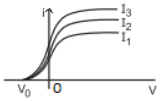
(A) The photoelectric current is higher for higher intensity of the incident radiation.
(B) The negative potential required to decrease the photocurrent at different intensities to zero is different.
(C) If the positive potential of the anode is increased beyond a certain value, the photocurrent does not increase for a given intensity.
(D) If the potential applied at the anode is zero, then the photocurrent is lower than the maximum value of current for the given intensity.
2025: 3 June Shift 1
Physics
Dual Nature of Radiation & Matter
Medium
In the experimental arrangement for study of photoelectric effect given below, P, Q, R and S, respectively are
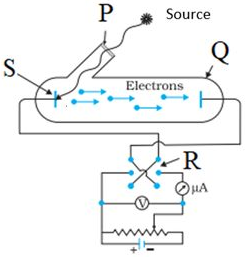
(A) Commutator
(B) Evacuated Glass Tube
(C) Photosensitive Plate
(D) Quartz Window
2025: 3 June Shift 1
Physics
Dual Nature of Radiation & Matter
Easy
Identify the basic features of the photon picture of electromagnetic radiation from the following.
(A) Each photon has energy in vacuum.
(B) Photons are electrically neutral and are not deflected by electric and magnetic fields.
(C) All photons of light of a particular frequency or wavelength have the same energy and momentum.
(D) If the intensity of light of a given wavelength is increased, there is an increase in the number of photons incident on a given area in a given time.
2025: 3 June Shift 1
Physics
Dual Nature of Radiation & Matter
Easy
The frequency of a photon whose energy is 66.3 eV would be
(Given Js)
2025: 2 June Shift 2
Physics
Dual Nature of Radiation & Matter
Medium
A monochromatic source emitting light of wavelength 600 nm has a power output of 66 W. The number of photons emitted by the source in 2 minutes is : (Given: Js)
2025: 2 June Shift 2
Physics
Dual Nature of Radiation & Matter
Medium
Light of wavelength 300 nm is used in an experiment on photoelectric effect with lithium having a work function of 2.7 eV. The maximum kinetic energy of ejected photo-electrons will be