
A long straight wire L carrying a current of 20 A rests on a table. Another wire AB of length 1 m and mass 2 g carries the same current but in opposite direction. The wire AB is free to move up and down. The value of height h to which AB rises and remains at rest there, will be.
(Given Tm/A, )
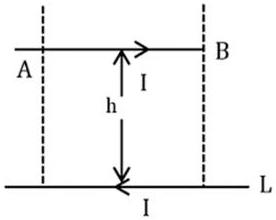
A long straight wire L carrying a current of 20 A rests on a table. Another wire AB of length 1 m and mass 2 g carries the same current but in opposite direction. The wire AB is free to move up and down. The value of height h to which AB rises and remains at rest there, will be.
(Given Tm/A, )
Solution
✅ Correct Option: 1
Opposite currents repel, so AB is pushed up until the magnetic repulsion balances its weight.
Force on AB (length ) due to wire L at distance equals the weight:
Related questions:
2025: 20 May Shift 2
2026: 26 May Shift 1