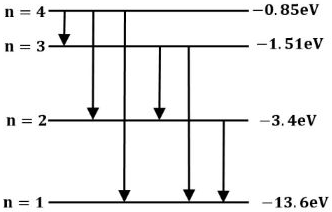
Which of the following is/are not TRUE for the Bohr’s atomic model?
A. Bohr’s model predicts the frequencies of the light emitted by hydrogenic atoms.
B. The Bohr model is applicable to the hydrogen like atoms.
C. Bohr’s model could also explain the relative intensity variations of hydrogen spectrum.
D. Bohr’s model can also be extended to more than one electron atoms like Helium
Solution
Statements C and D are false, so they are the ones that are not true.
Statement C is false because Bohr's model gives the frequencies of the spectral lines but cannot explain their relative intensities. Intensity depends on transition probabilities, which need quantum mechanics.
Statement D is false because Bohr's model works only for hydrogen and hydrogen-like (single-electron) species such as and . It fails for atoms with more than one electron, because it ignores electron-electron repulsion.
Statements A and B are true: the model predicts line frequencies for hydrogenic atoms, and it applies to hydrogen-like atoms.
Option 1 is a trap: it includes A and B, which are true, and a statement E that does not exist.
Option 2 gives only D, but C is also false, so it is incomplete.
Option 4 wrongly includes B, which is a true statement.
Related questions:
2026: 14 May Shift 2
2025: 26 May Shift 2
2026: 25 May Shift 1
2026: 30 May Shift 2
2026: 20 May Shift 2