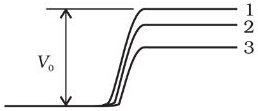
Which of the following statements are correct?
(A) In reverse bias of a p-n junction, negative terminal of the battery is connected to p-side of the junction,
(B) Reverse bias does not support the potential barrier at the junction.
(C) In reverse bias, a few minority charge carriers cross the junction.
(D) Resistance of p-n junction is high in reverse bias, reducing the current to a negligible value.
Solution
In reverse bias, the p-side is connected to the negative terminal and the n-side to the positive terminal, so (A) is correct. The applied voltage adds to the barrier voltage and widens the depletion region. Only a few minority carriers cross the junction, giving a tiny reverse (drift) current, so (C) is correct. The junction therefore has very high resistance in reverse bias and the current is negligible, so (D) is correct.
Statement (B) is wrong because reverse bias supports the potential barrier: it increases the barrier height, and it is forward bias that lowers it.
The reverse current is of the order of microamperes and is nearly independent of the applied voltage until breakdown.
Related questions:
2026: 21 May Shift 1
2026: 15 May Shift 1