
A network of five capacitors is shown in the figure. The total charge stored in the network connected between A and B is:
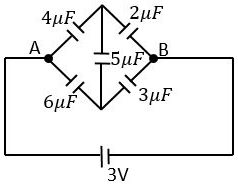
A network of five capacitors is shown in the figure. The total charge stored in the network connected between A and B is:
Solution
✅ Correct Option: 2
The bridge is balanced, so the capacitor carries no charge and can be ignored.
The top branch is and in series. Taking B at V and A at V, the voltage across the is V, so the top junction is at V.
The bottom branch is and in series. The voltage across the is V, so the bottom junction is also at V.
Both middle junctions are at the same potential, so no charge flows through the .
Equivalent capacitance of the two branches in parallel:
Total charge:
Option 4: the answer is in , not ; a unit slip of this kind is a common trap.
Related questions:
2025: 29 May Shift 2
2026: 7 June Shift 2
2026: 21 May Shift 1