
Two cells of emf 2 V and 4 V and internal resistance of each are connected with an external resistor of resistance as shown in the figure. The terminal potential difference of 2 V cell is:
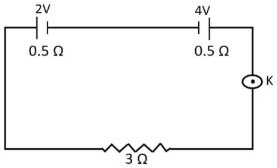
Two cells of emf 2 V and 4 V and internal resistance of each are connected with an external resistor of resistance as shown in the figure. The terminal potential difference of 2 V cell is:
Solution
✅ Correct Option: 1
The two cells are connected in opposition, so the 4 V cell drives the current and the 2 V cell is being charged.
Net emf V, and total resistance
A
The current enters the 2 V cell through its positive terminal, so its terminal voltage is greater than its emf:
Option 2: 1.75 V comes from wrongly using for the 2 V cell. That formula applies only when a cell is discharging, and here the 2 V cell is charging.
Related questions:
2026: 20 May Shift 2
2025: 16 May Shift 1