
A part of an infinitely long current carrying wire is bent into a circular shape as shown in the diagram. The magnetic field at the centre of the circle is
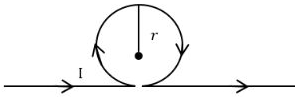
A part of an infinitely long current carrying wire is bent into a circular shape as shown in the diagram. The magnetic field at the centre of the circle is
Solution
The circular loop and the straight wire contribute fields in opposite directions at the centre.
Loop: the current goes up the left side, across the top and down the right side, so it is clockwise. The field at the centre is , directed into the page.
Straight wires: the two straight parts are semi-infinite, and each ends at the point of the wire nearest the centre, a perpendicular distance away. Each gives , so together . The current flows to the right and the centre lies above the wire, so by the right-hand rule this field points out of the page.
The loop field is larger, so the net field is inward:
Options 1 and 2: the fields oppose each other, so they subtract. They do not add to give .
Option 3: the loop field, which is larger, points inward. Outward would only be correct if the straight wire dominated.
Related questions:
2025: 20 May Shift 2
2026: 7 June Shift 2
2025: 16 May Shift 1
2025: 29 May Shift 1
2025: 3 June Shift 1