CUET Chemistry: ChemistryBiomolecules. Free, no login required.

Q1:

2025: 26 May Shift 2

Biomolecules

Easy

Carbohydrates are naturally formed organic compounds from various plants. The common chemical formula, (Cx(H2O)yC_x(H_2O)_y) was considered as hydrates of carbon to derive the various carbohydrates. For instance, the general formula for glucose (C6H12O6C_6H_{12}O_6) easily fits into the above formula. Carbohydrates also called saccharides are classified on the basis of their behavior towards hydrolysis. Monosaccharides cannot be hydrolyzed further to simpler units of polyhydroxy aldehyde or ketones. About 20 monosaccharides are known to occur in nature. Carbohydrates that yield large number of monosaccharide units are called polysacccharides. Amino acids contain (-NH2_2) and (-COOH), which can be classified in various forms. Proteins are polymers of alpha amino acids which are connected to each other by a peptide bond or peptide linkage. When a native protein is subjected to physical change, its globules unfold and helix get uncoiled and the protein loses its biological activity. The protein is said to be denaturated.

Which of the following statements is incorrect for Lactose ?
Answer options
Option 4
Correct Answer
Explanation for 2025: 26 May Shift 2 CHE question 1

Q2:

2025: 24 May Shift 2

Biomolecules

Easy

What kind of behavior is shown in the Zwitter ionic form of the amino acids?

Answer options
Option 2
Correct Answer
Explanation for 2025: 24 May Shift 2 CHE question 2

Q3:

2025: 24 May Shift 2

Biomolecules

Easy

Match List-I with List-II

List-IList-II
Name of Amino AcidOne letter code
(A) Phenylalanine(I) F
(B) Tyrosine(II) Y
(C) Asparagine(III) N
(D) Arginine(IV) R
Answer options
Option 1
Correct Answer
Explanation for 2025: 24 May Shift 2 CHE question 3

Q4:

2025: 24 May Shift 2

Biomolecules

Easy

DNA fingerprinting is used for:

(A) Forensic Laboratories for identification of criminals

(B) To identify paternity of an individual

(C) To identify the dead bodies by comparing the DNA of parents or children

(D) To identify racial groups, to rewrite biological evaluations.

Answer options
Option 2
Correct Answer
Explanation for 2025: 24 May Shift 2 CHE question 4

Q5:

2025: 24 May Shift 2

Biomolecules

Easy

Match List-I with List-II

List-IList-II
Name of VitaminDeficiency disease
(A) Vitamin A(I) Beri Beri
(B) Vitamin B1B_1(II) Scurvy
(C) Vitamin C(III) Rickets
(D) Vitamin D(IV) Xerophthalmia
Answer options
Option 2
Correct Answer
Explanation for 2025: 24 May Shift 2 CHE question 5

Q6:

2025: 24 May Shift 2

Biomolecules

Easy

Match List-I with List-II

List-IList-II
SugarExample
(A). Invert Sugar(I). Lactose
(B). Milk Sugar(II). Sucrose
(C). Dextrose(III). Fructose
(D) Ketohexose(IV). Glucose
Answer options
Option 1
Correct Answer
Explanation for 2025: 24 May Shift 2 CHE question 6

Q7:

2025: 23 May Shift 2

Biomolecules

Easy

Which structure of proteins gives rise to fibrous and globular proteins?

Answer options
Option 3
Correct Answer
Explanation for 2025: 23 May Shift 2 CHE question 7

Q8:

2025: 23 May Shift 2

Biomolecules

Medium

The correct sequence of attachment of sugar, base and phosphoric acid in a nucleic acid is

(A) Formation of phosphodiester linkage

(B) Attachment of base to 1' position of sugar

(C) Selection of appropriate base and sugar

(D) Attachment of phosphoric acid

Answer options
Option 1
Correct Answer
Explanation for 2025: 23 May Shift 2 CHE question 8

Q9:

2025: 23 May Shift 2

Biomolecules

Easy

Glucose reacts with Tollen's reagent (ammoniacal silver nitrate) due to the presence of

Answer options
Option 2
Correct Answer
Explanation for 2025: 23 May Shift 2 CHE question 9

Q11:

2025: 23 May Shift 2

Biomolecules

Easy

The function of the enzymes in various chemical reactions:

Answer options

Q12:

2025: 22 May Shift 1

Biomolecules

Medium

Milk sugar, a disaccharide, is composed of

Answer options

Q13:

2025: 22 May Shift 1

Biomolecules

Easy

The product of the following chemical reaction is

Glucose→Br2 water\text{Glucose} \xrightarrow{Br_2 \text{ water}}

Answer options

Q14:

2025: 22 May Shift 1

Biomolecules

Easy

Match List-I with List-II

List-IList-II
(A) Vitamin B1B_1(I) Ascorbic Acid
(B) Vitamin B2B_2(II) Pyridoxine
(C) Vitamin B6B_6(III) Riboflavin
(D) Vitamin C(IV) Thiamine
Answer options

Q16:

2025: 22 May Shift 1

Biomolecules

Easy

Which of the following is a straight chain polysaccharide composed only of β-D-glucose units?

Answer options

Q17:

2025: 21 May Shift 2

Biomolecules

Easy

Biomolecules are the organic compounds present as an essential constituents of living organisms in different cells. The molecules are generally termed as macromolecules.which are carbohydrates, enzymes, nucleic acids, amino acids and proteins etc. Carbohydrates are classified as sugars and non-sugars include sucrose, glucose, fructose, starch and cellulose. Enzymes are coordinated with various chemical reactions in nucleic acid. Nucleic acids are found in living organisms made up of proteins and natural polymers. Two types that are generally found in biological systems are DNA and RNA nucleic acid. Amino acids are bifunctional groups of carboxyl and amino groups. Proteins are a class of biologically important compounds. They are crucial to virtually all processes in living systems. Some of them are hormones, which serve as chemical messengers that coordinate certain biochemical activities.

The disaccharide present in milk is known as

Answer options

Q18:

2025: 21 May Shift 2

Biomolecules

Easy

Biomolecules are the organic compounds present as an essential constituents of living organisms in different cells. The molecules are generally termed as macromolecules.which are carbohydrates, enzymes, nucleic acids, amino acids and proteins etc. Carbohydrates are classified as sugars and non-sugars include sucrose, glucose, fructose, starch and cellulose. Enzymes are coordinated with various chemical reactions in nucleic acid. Nucleic acids are found in living organisms made up of proteins and natural polymers. Two types that are generally found in biological systems are DNA and RNA nucleic acid. Amino acids are bifunctional groups of carboxyl and amino groups. Proteins are a class of biologically important compounds. They are crucial to virtually all processes in living systems. Some of them are hormones, which serve as chemical messengers that coordinate certain biochemical activities.

Starch is a polymer of saccharides known as

Answer options

Q19:

2025: 21 May Shift 2

Biomolecules

Easy

Biomolecules are the organic compounds present as an essential constituents of living organisms in different cells. The molecules are generally termed as macromolecules.which are carbohydrates, enzymes, nucleic acids, amino acids and proteins etc. Carbohydrates are classified as sugars and non-sugars include sucrose, glucose, fructose, starch and cellulose. Enzymes are coordinated with various chemical reactions in nucleic acid. Nucleic acids are found in living organisms made up of proteins and natural polymers. Two types that are generally found in biological systems are DNA and RNA nucleic acid. Amino acids are bifunctional groups of carboxyl and amino groups. Proteins are a class of biologically important compounds. They are crucial to virtually all processes in living systems. Some of them are hormones, which serve as chemical messengers that coordinate certain biochemical activities.

Glucose when treated with Bromine water forms

Answer options

Q20:

2025: 21 May Shift 2

Biomolecules

Easy

Biomolecules are the organic compounds present as an essential constituents of living organisms in different cells. The molecules are generally termed as macromolecules.which are carbohydrates, enzymes, nucleic acids, amino acids and proteins etc. Carbohydrates are classified as sugars and non-sugars include sucrose, glucose, fructose, starch and cellulose. Enzymes are coordinated with various chemical reactions in nucleic acid. Nucleic acids are found in living organisms made up of proteins and natural polymers. Two types that are generally found in biological systems are DNA and RNA nucleic acid. Amino acids are bifunctional groups of carboxyl and amino groups. Proteins are a class of biologically important compounds. They are crucial to virtually all processes in living systems. Some of them are hormones, which serve as chemical messengers that coordinate certain biochemical activities.

Cane sugar on boiling with HCl or H2SO4\mathrm{H_2SO_4} hydrolysis yields

Answer options

Q21:

2025: 21 May Shift 2

Biomolecules

Easy

Biomolecules are the organic compounds present as an essential constituents of living organisms in different cells. The molecules are generally termed as macromolecules.which are carbohydrates, enzymes, nucleic acids, amino acids and proteins etc. Carbohydrates are classified as sugars and non-sugars include sucrose, glucose, fructose, starch and cellulose. Enzymes are coordinated with various chemical reactions in nucleic acid. Nucleic acids are found in living organisms made up of proteins and natural polymers. Two types that are generally found in biological systems are DNA and RNA nucleic acid. Amino acids are bifunctional groups of carboxyl and amino groups. Proteins are a class of biologically important compounds. They are crucial to virtually all processes in living systems. Some of them are hormones, which serve as chemical messengers that coordinate certain biochemical activities.

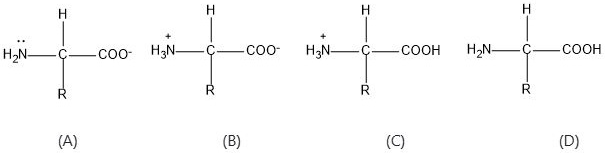
The zwitterionic form of amino acid is

Figure

Answer options

Q22:

2025: 21 May Shift 1

Biomolecules

Easy

Optically active polyhydroxy aldehydes or ketones or molecules which provide such units on hydrolysis are called carbohydrates. They can be broadly classified as monosaccharides, disaccharides and polysaccharides depending on their behavior towards hydrolysis. They are also classified as reducing or non reducing sugars. Another class of biomolecules is proteins which are polymers of twenty different amino acids linked by peptide bonds. Amino acids can be classified as acidic, basic or neutral depending on the relative number of amino and carboxyl groups in their molecule. The essential amino acids cannot be synthesized by our body and hence must be provided through diet. Nucleic acids are the polymers of nucleotides which in turn consist of a base, pentose sugar and phosphate. There are two types of nucleic acids namely, DNA and RNA which differ in the composition of sugar and a base.

Which of the following is non-reducing sugar?

Answer options

Q23:

2025: 21 May Shift 1

Biomolecules

Easy

Optically active polyhydroxy aldehydes or ketones or molecules which provide such units on hydrolysis are called carbohydrates. They can be broadly classified as monosaccharides, disaccharides and polysaccharides depending on their behavior towards hydrolysis. They are also classified as reducing or non reducing sugars. Another class of biomolecules is proteins which are polymers of twenty different amino acids linked by peptide bonds. Amino acids can be classified as acidic, basic or neutral depending on the relative number of amino and carboxyl groups in their molecule. The essential amino acids cannot be synthesized by our body and hence must be provided through diet. Nucleic acids are the polymers of nucleotides which in turn consist of a base, pentose sugar and phosphate. There are two types of nucleic acids namely, DNA and RNA which differ in the composition of sugar and a base.

The sugar moiety in DNA and RNA molecules, respectively, are

Answer options

Q24:

2025: 21 May Shift 1

Biomolecules

Easy

Optically active polyhydroxy aldehydes or ketones or molecules which provide such units on hydrolysis are called carbohydrates. They can be broadly classified as monosaccharides, disaccharides and polysaccharides depending on their behavior towards hydrolysis. They are also classified as reducing or non reducing sugars. Another class of biomolecules is proteins which are polymers of twenty different amino acids linked by peptide bonds. Amino acids can be classified as acidic, basic or neutral depending on the relative number of amino and carboxyl groups in their molecule. The essential amino acids cannot be synthesized by our body and hence must be provided through diet. Nucleic acids are the polymers of nucleotides which in turn consist of a base, pentose sugar and phosphate. There are two types of nucleic acids namely, DNA and RNA which differ in the composition of sugar and a base.

Four bases present in RNA molecule are

Answer options

Q25:

2025: 21 May Shift 1

Biomolecules

Medium

Optically active polyhydroxy aldehydes or ketones or molecules which provide such units on hydrolysis are called carbohydrates. They can be broadly classified as monosaccharides, disaccharides and polysaccharides depending on their behavior towards hydrolysis. They are also classified as reducing or non reducing sugars. Another class of biomolecules is proteins which are polymers of twenty different amino acids linked by peptide bonds. Amino acids can be classified as acidic, basic or neutral depending on the relative number of amino and carboxyl groups in their molecule. The essential amino acids cannot be synthesized by our body and hence must be provided through diet. Nucleic acids are the polymers of nucleotides which in turn consist of a base, pentose sugar and phosphate. There are two types of nucleic acids namely, DNA and RNA which differ in the composition of sugar and a base.

The side chain (R group) present in the "Aspartic Acid" amino acid is

Answer options

Q26:

2025: 21 May Shift 1

Biomolecules

Easy

Optically active polyhydroxy aldehydes or ketones or molecules which provide such units on hydrolysis are called carbohydrates. They can be broadly classified as monosaccharides, disaccharides and polysaccharides depending on their behavior towards hydrolysis. They are also classified as reducing or non reducing sugars. Another class of biomolecules is proteins which are polymers of twenty different amino acids linked by peptide bonds. Amino acids can be classified as acidic, basic or neutral depending on the relative number of amino and carboxyl groups in their molecule. The essential amino acids cannot be synthesized by our body and hence must be provided through diet. Nucleic acids are the polymers of nucleotides which in turn consist of a base, pentose sugar and phosphate. There are two types of nucleic acids namely, DNA and RNA which differ in the composition of sugar and a base.

"Maltose" disaccharide is composed of

Answer options

Q27:

2025: 19 May Shift 2

Biomolecules

Easy

When a protein in its native form is subjected to physical or chemical change, then its

Answer options

Q28:

2025: 19 May Shift 2

Biomolecules

Easy

Match List-I (type of linkages) with List-II (Biomolecules)

List-IList-II
Type of linkageBiomolecule
(A) Glycosidic linkage(I) Tertiary structure of proteins
(B) Peptide Linkage(II) Disaccharide
(C) Phosphodiester linkage(III) Primary structure of proteins
(D) Disulfide linkage(IV) Nucleotide
Answer options

Q29:

2025: 19 May Shift 2

Biomolecules

Medium

Addison's disease is not characterised by

Answer options

Q30:

2025: 19 May Shift 2

Biomolecules

Easy

When a nucleotide from DNA containing adenine is hydrolyzed, the products obtained are

Answer options