Q1:
2026: 21 May Shift 2
Physics
Ray Optics & Optical Instruments
Medium
An object is placed in front of an equiconvex lens of focal length 10 cm. The two object distances for which image will be four times the size of object are:
2026: 21 May Shift 2
Physics
Ray Optics & Optical Instruments
Medium
An object is placed in front of an equiconvex lens of focal length 10 cm. The two object distances for which image will be four times the size of object are:
2026: 21 May Shift 2
Physics
Ray Optics & Optical Instruments
Easy
When white light enters a glass prism it splits into its constituent colours. This is due to:
2026: 21 May Shift 2
Physics
Ray Optics & Optical Instruments
Medium
Identify the correct statements among the following about ray optics and optical instruments. .
A. Law of reflection and refraction are true for all surfaces and pair of media at the point of the incidence.
B. Thick lenses give coloured images due to diffraction.
C. In simple microscope, the angular size of the object equals the angular size of image.
D. Optical fibres consist of glass fibres coated with a thin layer of higher refractive index.
2026: 21 May Shift 2
Physics
Ray Optics & Optical Instruments
Easy
Two thin lenses of focal lengths +10 cm and -5 cm are kept in contact. The power of combination is :
2026: 21 May Shift 1
Physics
Ray Optics & Optical Instruments
Easy
In modern microscopes, the quality of image is improved by
2026: 21 May Shift 1
Physics
Ray Optics & Optical Instruments
Easy
One problem of a reflecting telescope is that its
2026: 21 May Shift 1
Physics
Ray Optics & Optical Instruments
Medium
The two possible positions of an object kept in front of a lens of power + 10 D, so that the image formed in both cases is five times magnified, are:
2026: 21 May Shift 1
Physics
Ray Optics & Optical Instruments
Easy
In the total internal reflection, light ray traveling through an optically denser medium to a rarer medium at the interface,
2026: 21 May Shift 1
Physics
Ray Optics & Optical Instruments
Medium
The refracting angle of a prism is A, and refractive index of the material of the prism is cot (A/2). The angle of minimum deviation is
2026: 20 May Shift 2
Physics
Ray Optics & Optical Instruments
Medium
For refraction through an equilateral glass prism, at minimum deviation ( = ), which of the following is correct?
2026: 20 May Shift 2
Physics
Ray Optics & Optical Instruments
Easy
A ray of light enters from a denser medium to a rarer medium. The refracted ray is bent so much away from the normal that it grazes the surface at the interface between the two media. This will happen
2026: 20 May Shift 2
Physics
Ray Optics & Optical Instruments
Medium
The power of a lens is +5 D. This lens is cut vertically into two equal halves. An object is placed at 80 cm from one of the two lenses on its axis. The image will be formed at
2026: 20 May Shift 2
Physics
Ray Optics & Optical Instruments
Easy
Match the LIST-I with LIST-II
| LIST-I (Optical Device) | LIST-II (Application) | ||
|---|---|---|---|
| A. | Compound Microscope | I. | To facilitate visual examination of internal organs like intestines |
| B. | Optical Fibers | II. | To invert image without changing its size |
| C. | Astronomical Telescope | III. | To see distant objects |
| D. | Prism | IV. | To see tiny objects |
2026: 20 May Shift 1
Physics
Ray Optics & Optical Instruments
Easy
Arrange the following in the correct order as the angle of incidence in a denser medium is gradually increased.
(A) The refracted ray bends away from the normal.
(B) The refracted ray grazes along the surface of separation.
(C) The light is totally reflected back into the denser medium.
(D) The ray passes undeviated when incident normally.
2026: 20 May Shift 1
Physics
Ray Optics & Optical Instruments
Hard
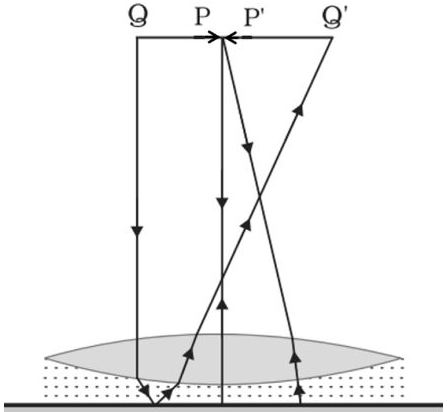
The figure below shows an equiconvex lens (n = 1.5) placed in contact with a thin liquid layer resting on a plane mirror. A small needle, with its tip positioned on the principal axis of the lens, is moved along the axis until its inverted image coincides with the needle tip itself.
When the liquid is present, the distance between the needle and the lens is found to be 50 cm. The experiment is then repeated after removing the liquid, and the distance is observed to be 35 cm. The refractive index of the liquid is-

2026: 20 May Shift 1
Physics
Ray Optics & Optical Instruments
Easy
Arrange the following in increasing order of focal length of a given lens.
(A) - focal length for violet colour
(B) - focal length for blue colour
(C) - focal length for yellow colour
(D) - focal length for red colour
2026: 20 May Shift 1
Physics
Ray Optics & Optical Instruments
Easy
The radius of curvature of the curved surface of a plano – convex lens is 20 cm. If the refractive index of the material of the lens is 1.5, it will
2026: 20 May Shift 1
Physics
Ray Optics & Optical Instruments
Easy
Light is incident on an interface between water (refractive index = 1.33) and glass (refractive index = 1.5). For total internal reflection, light should be traveling from
( is the critical angle)
2026: 19 May Shift 2
Physics
Ray Optics & Optical Instruments
Easy
If the red light is replaced by a blue light, which of the following statements related to the focal length of a lens is correct?
2026: 19 May Shift 2
Physics
Ray Optics & Optical Instruments
Medium
A real image is obtained at a distance of 20 cm from the lens P. When one more lens Q is kept in contact with this lens, the image is shifted 10 cm towards the combined lenses. The focal length of the lens Q is
2026: 19 May Shift 2
Physics
Ray Optics & Optical Instruments
Medium
An object placed in front of a concave mirror of focal length 20 cm makes (i) a real image and (ii) a virtual image with magnification 4 in both the cases. The position of the object in two cases respectively, will be:
2026: 19 May Shift 2
Physics
Ray Optics & Optical Instruments
Easy
The refractive index of a convex lens is 1.5. If it is immersed in a solution of refractive index 1.6, then
2026: 19 May Shift 2
Physics
Ray Optics & Optical Instruments
Easy
An equiconvex lens of focal length 10 cm is cut into two identical planoconvex lenses. The focal length of each planoconvex lens will be:
2026: 19 May Shift 1
Physics
Ray Optics & Optical Instruments
Easy
Two thin lenses of focal length and are placed co-axially in contact. The power of the combination is
2026: 19 May Shift 1
Physics
Ray Optics & Optical Instruments
Medium
The angle of incidence in minimum deviation position for an equilateral prism is . The refractive index of the prism is
2026: 18 May Shift 2
Physics
Ray Optics & Optical Instruments
Easy
Which of the following phenomena is used for propagation of light in optical fibres?
2026: 18 May Shift 2
Physics
Ray Optics & Optical Instruments
Easy
The objective of a compound microscope forms an image which is
2026: 18 May Shift 2
Physics
Ray Optics & Optical Instruments
Easy
The refractive index of a glass is 1.520 for red light and 1.525 for blue light. If the angles of deviation be and for red and blue light, respectively, in a thin prism of this glass, then
2026: 18 May Shift 2
Physics
Ray Optics & Optical Instruments
Medium
A concave lens of glass of refractive index 1.5 has both surfaces of the same radius of curvature R. On immersing the lens in a medium of refractive index 1.75, it will behave as a
2026: 18 May Shift 1
Physics
Ray Optics & Optical Instruments
Easy
Given below are some media. Arrange them in increasing order of their refractive indices.
(A) Crown glass
(B) Dense flint glass
(C) Water
(D) Diamond