Q1:
2026: 26 May Shift 2
Physics
Ray Optics & Optical Instruments
Easy
Arrange the values of the refractive index of the following in the decreasing order.
A. Water
B. Diamond
C. Dense flint glass
D. Crown glass
2026: 26 May Shift 2
Physics
Ray Optics & Optical Instruments
Easy
Arrange the values of the refractive index of the following in the decreasing order.
A. Water
B. Diamond
C. Dense flint glass
D. Crown glass
2026: 26 May Shift 2
Physics
Ray Optics & Optical Instruments
Easy
Match the LIST-I with LIST-II (Symbols have their usual meaning)
| LIST-I The nature of an image formed by a concave mirror. | LIST-II Position of Object | ||
|---|---|---|---|
| A. | Inverted, real and magnified | I. | Between P and F |
| B. | Inverted, real and same size | II. | Between C and infinity |
| C. | Inverted, real and diminished | III. | At C |
| D. | Erect, virtual and magnified | IV. | Between F and C |
2026: 26 May Shift 2
Physics
Ray Optics & Optical Instruments
Easy
The magnification of a refracting type telescope is 4. The separation between the objective and the eyepiece is 35 cm and the final image is formed at infinity. The focal lengths of the objective and eyepiece are, respectively.
2026: 26 May Shift 1
Physics
Ray Optics & Optical Instruments
Medium
The refractive indices of the material of a lens for yellow and red lights are 1.54 and 1.51, respectively. If the focal length of the lens for red light is 36.0 cm, the focal length of the lens for yellow light will be
2026: 26 May Shift 1
Physics
Ray Optics & Optical Instruments
Medium
Arrange the speed of light in ascending order for the following cases of media wherein for the same angle of incidence, the angle of refraction in them are as given below:
(A)
(B)
(C)
(D)
2026: 26 May Shift 1
Physics
Ray Optics & Optical Instruments
Hard
An object O is placed at a distance of 0.2 m to the left of a convex lens of focal length 0.1 m. A concave mirror of focal length 0.05 m is placed at a distance of 0.3 m to the right of the lens. The nature and position of the final image will be
2026: 26 May Shift 1
Physics
Ray Optics & Optical Instruments
Medium
A planet is observed by an astronomical refracting telescope in normal adjustment position having an objective of 2 D cm and an eyepiece of 20 D.
(A) The distance between the objective and the eyepiece is 55 cm.
(B) The effective object distance for the eye piece is 5 cm.
(C) The final image formed is inverted.
(D) The angular magnification of the telescope is 20.
2026: 25 May Shift 2
Physics
Ray Optics & Optical Instruments
Medium
Match List-I with List-II,
(Symbols have their usual meaning, D is the least distance of the distinct vision)
| List-I | List-II |
|---|---|
| Optical Instrument | Magnifying Power |
| (A) For a simple microscope the magnifying power when the final image is at near point | (I) |
| (B) For a compound microscope, the magnifying power is | (II) |
| (C) For a astronomical telescope to see distant objects, the magnifying power is | (III) |
| (D) For a simple microscope, when the final image is infinity, the magnifying power is | (IV) |
2026: 25 May Shift 2
Physics
Ray Optics & Optical Instruments
Easy
Identify the incorrect statement among the following:
2026: 25 May Shift 2
Physics
Ray Optics & Optical Instruments
Medium
The radii of curvature of two surfaces of a convex lens are 10 cm and 20 cm, respectively. The focal length of the lens in air is 20 cm. The refractive index of the material of the lens is;
2026: 25 May Shift 2
Physics
Ray Optics & Optical Instruments
Medium
Identify the correct statement(s) among the following;
(A) When a light ray enters a denser medium, the speed of the ray decreases.
(B) In the phenomenon of total internal reflection, refraction also occurs in the denser medium.
(C) In the process of total internal reflection, the laws of reflection doesn't follow.
(D) When a ray is totally internally reflected, it's energy doesn't change.
2026: 25 May Shift 2
Physics
Ray Optics & Optical Instruments
Easy
The refractive indices for glass and water are 3/2 and 4/3, respectively. The refractive index of glass with respect to water is;
2026: 25 May Shift 1
Physics
Ray Optics & Optical Instruments
Medium
Match the LIST-I with LIST-II
| LIST-I (Instrument) | LIST-II (Characteristics) | ||
|---|---|---|---|
| A. | Simple magnifier | I. | The eyepiece is smaller than the objective lens |
| B. | Prism | II. | Converging lens of small focal length |
| C. | Compound Microscope | III. | Dispersion |
| D. | Telescope | IV. | The eyepiece is of larger focal length than the objective lens |
2026: 25 May Shift 1
Physics
Ray Optics & Optical Instruments
Easy
A convex lens is dipped in a liquid whose refractive index is equal to the refractive index of the lens. Then its focal length will:
2026: 25 May Shift 1
Physics
Ray Optics & Optical Instruments
Hard
Arrange the focal lengths of the following lenses made of glass in ascending order.
A. A convex lens, each face having radius of curvature 1 m
B. When image is formed at 40 cm from a lens with linear magnification
C. Lens of power 0.1 D
D. When image is at a far point and angular magnification is 1
2026: 25 May Shift 1
Physics
Ray Optics & Optical Instruments
Easy
Arrange the following media according to velocity of a laser beam in them in ascending order.
A. Flint glass
B. Diamond
C. Water
D. Air
2026: 25 May Shift 1
Physics
Ray Optics & Optical Instruments
Easy
A convex lens is making full image of an object. If half of the lens is covered by an opaque object, then:
2026: 24 May Shift 1
Physics
Ray Optics & Optical Instruments
Easy
To have a simple microscope of linear magnifiaction = 7.25 for the image to be formed at the near point D = 25 cm, the focal length of its convex lens should be?.
2026: 24 May Shift 1
Physics
Ray Optics & Optical Instruments
Hard
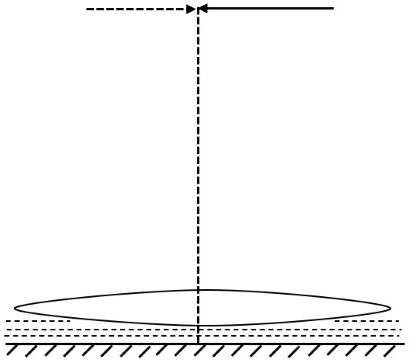
An equiconvex lens with radii of curvature R each, is put over a liquid layer (refractive index ) poured on top of a plane mirror. A small needle with its tip on the principal axis of the lens is moved along the axis until its inverted real image coincides with the needle itself. The distance of the needle from the lens is measured to be 'x'. On removing the liquid layer and repeating the experiment the distance is found to be 'y'. The value of 'x' can be expressed as:

2026: 24 May Shift 1
Physics
Ray Optics & Optical Instruments
Medium
A prism of prism angle A has one of its refracting surface silvered. Light rays falling at an angle of incidence 3A on the first surface return back through the same path after suffering reflection at the second (silvered) surface. The refractive index of the material of prism is
2026: 24 May Shift 1
Physics
Ray Optics & Optical Instruments
Easy
Match List-I with List-II
| List-I | List-II |
|---|---|
| Properties/Characteristics | Type of optical instrument |
| (A) Gives maximum possible magnification for realistic focal lengths. | (I) Cassegrain Telescope |
| (B) Objective- Small Aperture, Eyepiece- Large Aperture | (II) Simple Microscope |
| (C) Concave mirror is used as Objective | (III) Refracting type telescope |
| (D) Objective- Large Aperture, Eyepiece- Smaller Aperture | (IV) Compound Microscope |
2026: 22 May Shift 2
Physics
Ray Optics & Optical Instruments
Hard
The radius of curvature of each surface of a biconvex lens is 30 cm and the refractive index of the material of the lens is 1.5. An object is placed at 75 cm from the lens, the image is formed at distance from the lens. In a sitauation when the refractive index of the material of lens is 1.6, the image is formed for the same object at distance from the lens. The difference between and is
2026: 22 May Shift 2
Physics
Ray Optics & Optical Instruments
Easy
Which one of the following relation is CORRECT for refraction through a glass prism at minimum deviation ?
[Symbols have their usual meaning]
2026: 22 May Shift 2
Physics
Ray Optics & Optical Instruments
Easy
Three convex lenses of focal lengths 10 cm, 30 cm and 60 cm and two concave lenses of focal lengths 20 cm and 40 cm are placed in contact co-axially. The power of the combination of the lenses is
2026: 22 May Shift 2
Physics
Ray Optics & Optical Instruments
Medium
The radii of curvature of a biconvex lens are 20 cm and 30 cm respectively, the refractive index of the material of the lens is 1.5. Now the lens is immersed in a liquid of refractive index 1.8, the nature and the focal length of the lens will become
2026: 22 May Shift 1
Physics
Ray Optics & Optical Instruments
Medium
A screen is placed 80 cm from an object. The image of the object on the screen is formed by a convex lens placed between them at two different locations separated by a distance 20 cm. The focal length of the lens is
2026: 22 May Shift 1
Physics
Ray Optics & Optical Instruments
Easy
Match List-I with List-II (Symbols have their usual meaning)
| List-I | List-II |
|---|---|
| Parameter | Optical Instrument |
| (A) No chromatic aberration | (I) Simple microscope |
| (B) Magnifying power | (II) Length of compound microscope |
| (C) Magnifying power | (III) Reflecting type telescope |
| (D) | (IV) Refracting type telescope |
2026: 22 May Shift 1
Physics
Ray Optics & Optical Instruments
Easy
A spherical air bubble is embedded in a piece of glass. For a ray of light passing through the bubble, it behaves like a
2026: 22 May Shift 1
Physics
Ray Optics & Optical Instruments
Easy
A lens of power + 5 D has a focal length equal to
2026: 21 May Shift 2
Physics
Ray Optics & Optical Instruments
Medium
Arrange the the following media according to the critical angle with respect to air in descending order.
A. Dense flint glass
B. Water
C. Crown Glass
D. Diamond