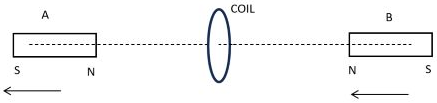
A copper coil is placed with its axis horizontally from left to right. The N pole of a bar magnet is moved towards the coil parallel to its axis. The induced current produces a magnetic field in the coil. In this context, identify the correct statements among the following.
A. If the magnet is moved towards the coil, the coil tries to move away as the magnetic pole induced in the coil will be N pole.
B. If the speed of the magnet is increased, then the coil moves away faster from the magnet.
C. If the pole of the magnet is reversed such that the S pole is moved towards the coil, then the coil is moved away from the magnet.
D. If the magnet is kept static, then no movement in the coil is observed.
Solution
By Lenz's law, the induced current opposes the change causing it. When a pole approaches the coil, the face of the coil nearest the magnet becomes the same kind of pole, so the coil and magnet repel. The coil is therefore pushed away from the approaching magnet.
A is correct: as the N pole approaches, the near face of the coil becomes an N pole and repels the magnet, so the coil tries to move away.
B is correct: a higher speed means a faster rate of change of flux, so the induced emf and current are larger. The repulsion is stronger and the coil moves away faster.
C is correct: if the S pole approaches, the near face of the coil becomes an S pole. This is again repulsion, so the coil moves away.
D is correct: a static magnet gives no change in flux, so there is no induced emf, no current and no force. The coil stays at rest.
Related questions:
2025: 2 June Shift 1
2025: 2 June Shift 2