
A long insulated copper wire carrying current I is given a almost circular bend of radius r as shown in the figure. The magnetic field at the center O is
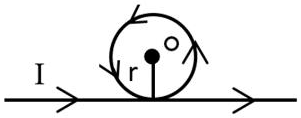
A long insulated copper wire carrying current I is given a almost circular bend of radius r as shown in the figure. The magnetic field at the center O is
Solution
The loop and the straight wire both contribute at O. Their fields add if they point the same way.
Circular loop: the current runs counterclockwise (up on the right side, left across the top), so by the right-hand rule the field at O points out of the paper.
Long straight wire: O lies a perpendicular distance above the wire, which carries current to the right. The field at O is again out of the paper.
Both fields point out of the paper, so they add.
Options 2 and 4: they subtract the two fields, which would be right only if the loop and the wire gave opposite directions.
Option 1: it has the correct magnitude, but "into the paper" is the wrong direction for this loop current.
Related questions:
2026: 6 June Shift 1
2026: 25 May Shift 1
2025: 15 May Shift 1
2025: 3 June Shift 2