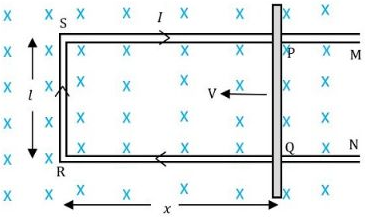
A glass rod of length L moves with velocity v perpendicular to a uniform magnetic field B. The induced emf would be-
A glass rod of length L moves with velocity v perpendicular to a uniform magnetic field B. The induced emf would be-
Solution
✅ Correct Option: 3
Motional emf in a rod comes from free charges being pushed to its ends by the magnetic force . This builds up a potential difference across the rod.
Glass is an insulator and has no free charge carriers, so no charge separates along its length. The induced emf is therefore .
Option 2: is the motional emf for a conducting (e.g. metal) rod, not an insulating glass rod.
Related questions:
2026: 7 June Shift 2
2025: 15 May Shift 2