
Match List-I with List-II (Symbols have their usual meaning)
List-I List-II (a.c. circuit) (Phasor diagram) (A) Pure Capacitive circuit (I) 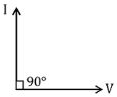
(B) Pure Inductive circuit (II) 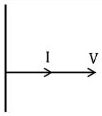
(C) LCR-Series circuit at resonance (III) 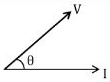
(D) LCR- Series circuit (IV) 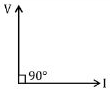
Match List-I with List-II (Symbols have their usual meaning)
| List-I | List-II |
|---|---|
| (a.c. circuit) | (Phasor diagram) |
| (A) Pure Capacitive circuit | (I) |
| (B) Pure Inductive circuit | (II) |
| (C) LCR-Series circuit at resonance | (III) |
| (D) LCR- Series circuit | (IV) |
Solution
✅ Correct Option: 4
| List I | List II |
|---|---|
| (A) Pure Capacitive circuit | (I) Current phasor is ahead of voltage |
| (B) Pure Inductive circuit | (IV) Voltage phasor is ahead of current |
| (C) LCR-Series circuit at resonance | (II) and along the same line (in phase) |
| (D) LCR-Series circuit | (III) at an angle to |
Memory trick, "CIVIL": in a Capacitor, I leads V; in an inductor (L), V leads I.
At resonance , so the circuit behaves as purely resistive and the phase angle is zero. In a general LCR circuit, , so is non-zero.
Related questions:
2025: 14 May Shift 2