
In the given electric circuit four cells of emf 1 V, 2 V, 3 V, 1 V, and internal resistances , , , , respectively, are connected. The current through resistance of connected between the two diagonal points (B and D) is:
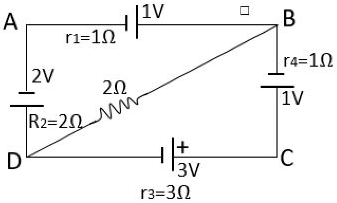
In the given electric circuit four cells of emf 1 V, 2 V, 3 V, 1 V, and internal resistances , , , , respectively, are connected. The current through resistance of connected between the two diagonal points (B and D) is:
Solution
Take the junctions B and D as the two nodes, with and . The two outer branches are each a pair of cells in series.
Branch D-A-B has total resistance , and its cells (2 V and 1 V) oppose, so the net emf is V, acting from B towards D.
Branch D-C-B has total resistance , and its cells (3 V and 1 V) oppose, so the net emf is V, acting from D towards B.
The currents arriving at B through the two outer branches must leave through the resistor (Kirchhoff's junction rule):
Related questions:
2025: 29 May Shift 1
2026: 19 May Shift 1
2025: 26 May Shift 2