A magnet bar placed along the axis of two identical coils moves towards left with constant speed. Then
(A) The end q of the first coil acquires south(S) polarity.
(B) The end x of the second coil acquires northern (N) polarity
(C) The induced current will be produced in first coil pq only.
(D) Induced current of same magnitude will be produced in both the coils.
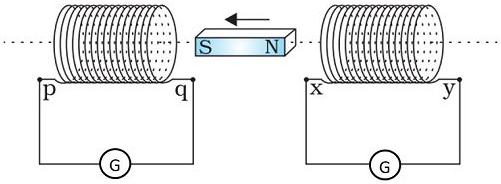
A magnet bar placed along the axis of two identical coils moves towards left with constant speed. Then
(A) The end q of the first coil acquires south(S) polarity.
(B) The end x of the second coil acquires northern (N) polarity
(C) The induced current will be produced in first coil pq only.
(D) Induced current of same magnitude will be produced in both the coils.
Solution
The magnet moves left, so its S pole approaches the first coil and its N pole moves away from the second coil. By Lenz's law, the induced polarity opposes this change.
First coil: the S pole approaches end q, so q must repel it and becomes S. Statement (A) is correct.
Second coil: the N pole recedes from end x, so x must attract it and becomes S, not N. Statement (B) is wrong.
Both coils see a changing flux, so current is induced in both. Statement (C) is wrong.
The coils are identical and the magnet moves with constant speed, so the rate of change of flux, and hence the induced current, is the same in magnitude in both. Statement (D) is correct.
Option 1: (B) is wrong because the receding N pole makes the near end x an S pole, not N.
Option 2: (C) is wrong because a coil gets induced current whenever its flux changes, whether the magnet approaches or recedes.
Direction of the current differs in the two coils, but the magnitude is the same.
Related questions:
2025: 20 May Shift 2
2025: 15 May Shift 2
2026: 29 May Shift 2