Which of the following statement(s) is/are incorrect?
(A) The Kirchhoff's laws are equally applicable in alternating current circuit and direct current circuits,
(B) It is not necessary that the wire stretched on the meter bridge must have a uniform cross-sectional area.
(C) The internal resistance of the cell does not affect the reading of the null point in metre bridge.
(D) Electrical potential has no direction, the electrical potential gradient has a direction.
Solution
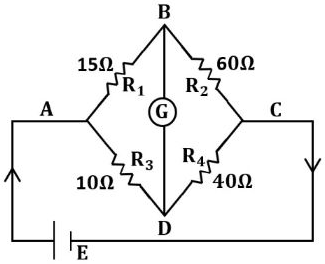
The meter bridge works on the balance condition , which holds only if the resistance of the wire is proportional to its length. This needs a wire of uniform cross-sectional area, so statement (B) is incorrect.
(A): correct, since Kirchhoff's laws are based on conservation of charge and energy and hold for instantaneous values in both AC and DC circuits.
(C): correct, because at the null point no current flows through the galvanometer, so the balance condition does not depend on the cell's internal resistance.
(D): correct, because potential is a scalar, while the potential gradient is a vector.
Related questions:
2026: 25 May Shift 1
2025: 3 June Shift 1