
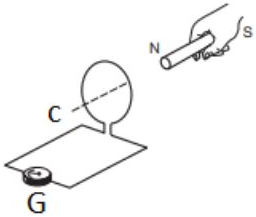
Figure shows a coil C connected to a galvanometer G. When the North-pole of a bar magnet is pushed towards the coil, the pointer in the galvanometer deflects. Regarding this set up, the following statements are given:
(A) It indicates the presence of electric current in the coil.
(B) The deflection is found to be smaller when the magnet is pushed towards the coil faster.
(C) There is repulsion in the moving magnet and the magnetic pole induced in the coil facing towards the N pole of the magnet.
(D) If the bar magnet does not move, there is no induced current in the coil.
Solution
Moving the magnet changes the flux through the coil, which induces an emf and a current. So (A) is true. By Lenz's law, the induced current opposes the approaching N pole, so the face of the coil toward the magnet becomes a north pole and repels it. So (C) is true. With the magnet at rest, the flux does not change, so no current is induced. So (D) is true.
Statement (B) is false because the induced emf is . Pushing the magnet faster makes the flux change faster, so the deflection is larger, not smaller.
Options 2, 3 and 4: each includes (B), which wrongly says a faster push gives a smaller deflection.
Related questions:
2025: 19 May Shift 1
2026: 25 May Shift 2