
An electric dipole consists of charges C, separated by a distance of 2 mm. It is placed on the right side near a long line charge of density C m. The negative charge of dipole is at a distance of 2 cm from the line charge as shown in figure. A positive charge (+2q) is placed on the left at 2 cm at point C. Given C
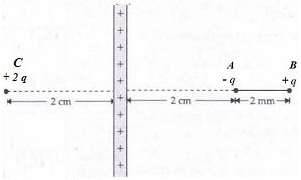
(A) Force exerted on negative charge at point A due to line charge
(B) Force exerted on positive charge at point B due to line charge
(C) Net force on the dipole due to line charge
(D) Force exerted on charge +2q at point C due to line charge
If the forces are arranged in decreasing order, then
An electric dipole consists of charges C, separated by a distance of 2 mm. It is placed on the right side near a long line charge of density C m. The negative charge of dipole is at a distance of 2 cm from the line charge as shown in figure. A positive charge (+2q) is placed on the left at 2 cm at point C. Given C
(A) Force exerted on negative charge at point A due to line charge
(B) Force exerted on positive charge at point B due to line charge
(C) Net force on the dipole due to line charge
(D) Force exerted on charge +2q at point C due to line charge
If the forces are arranged in decreasing order, then
Solution
Field of a long line charge at distance :
N m C... in SI units, so
Force on at A ( cm):
N
Force on at B ( cm):
N
Force on at C ( cm):
N
The force on A and the force on B are in opposite directions (the line charge attracts and repels , both along the same line), so the net force on the dipole is their difference:
N
| Force | Value (N) |
|---|---|
| (D) | 14.4 |
| (A) | 7.2 |
| (B) | 6.55 |
| (C) | 0.65 |
Related questions:
2026: 22 May Shift 2
2026: 26 May Shift 1
2026: 26 May Shift 1
2025: 16 May Shift 1