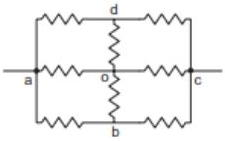
Four resistors, , , , and are connected in the form of a closed loop. A current of 2 A is flowing through point A and leaving the loop from point C. The potential difference will be
Four resistors, , , , and are connected in the form of a closed loop. A current of 2 A is flowing through point A and leaving the loop from point C. The potential difference will be
Solution
✅ Correct Option: 2
Both paths from A to C (A-B-C and A-D-C) have resistance , so the 2 A current splits equally, with 1 A in each path.
Potential drop from A to B:
Potential drop from A to D:
Related questions:
2025: 14 May Shift 2
2025: 28 May Shift 1
2025: 2 June Shift 2
2026: 6 June Shift 1
2025: 15 May Shift 1