
A wire carries a current of 5 A and consists of a circular arc of radius cm and central angle rad, and the two straight sections of the wire which intersect at the center of the arc. The magnetic field produced at the center of the arc is
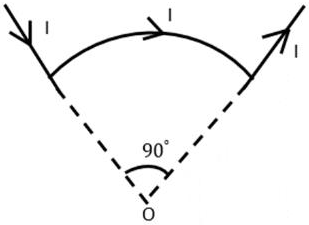
A wire carries a current of 5 A and consists of a circular arc of radius cm and central angle rad, and the two straight sections of the wire which intersect at the center of the arc. The magnetic field produced at the center of the arc is
Solution
✅ Correct Option: 2
Both straight sections lie along lines passing through the center O, so they produce no field there. Only the arc contributes.
For an arc of radius subtending angle at the center:
The current flows clockwise around O along the arc, so by the right-hand rule the field at O points into the plane of the paper.
Related questions:
2026: 22 May Shift 1
2026: 20 May Shift 2