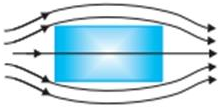
For Diamagnetic materials
(A)
(B)
(C)
(D)
For Diamagnetic materials
(A)
(B)
(C)
(D)
Solution
✅ Correct Option: 4
For a diamagnetic material, the induced magnetisation opposes the applied field, so the susceptibility is negative: . Since , this gives , and so .
Statements (B), (C) and (D) are therefore true.
(A): holds for paramagnetic and ferromagnetic materials, where and .
A superconductor is the ideal diamagnet, with and , which is why the range includes the end values and .
Related questions:
2025: 29 May Shift 1
2025: 27 May Shift 2
2025: 28 May Shift 1