Q1:
2026: 14 May Shift 2
Physics
Wave Optics
Medium
A single slit of width 0.01 mm gives a diffraction pattern using a light of wavelength 400 nm. The first secondary maxima occurs at an angle
Correct Answer
Option 2
Correct Answer

2026: 14 May Shift 2
Physics
Wave Optics
Medium
A single slit of width 0.01 mm gives a diffraction pattern using a light of wavelength 400 nm. The first secondary maxima occurs at an angle
2026: 14 May Shift 2
Physics
Wave Optics
Easy
In an experiment, two polarizers are arranged such that the angle between their pass axes is . If the intensity of light after passing through the first polarizer is 10 mW/m, then what is the intensity of light after passing through the second polarizer?
2026: 14 May Shift 2
Physics
Wave Optics
Easy
The phase difference between two interfering waves producing 1st dark fringe in Young's double slit experiment is
2026: 12 May Shift 2
Physics
Wave Optics
Easy
In a Young's double slit experiment the wavelength of light is 500 nm, the separation between the slits is 2 mm and the distance between the slits and the screen is 1.8 m. The width of bright fringes is
2026: 12 May Shift 2
Physics
Wave Optics
Easy
A light of wavelength m from air is incident on a glass slab of refractive index 1.5. The wavelength of the refracted light will be
2025: 3 June Shift 2
Physics
Wave Optics
Medium
In a single slit diffraction experiment, the aperture of the slit is 3 mm. A monochromatic light of wavelength 620 nm is normally incident on the slit. If the distance between the slit and the screen is 1.2 m, then the separation between the first order minima and the third order maxima on one side of the screen is
2025: 3 June Shift 1
Physics
Wave Optics
Easy
Two waves of amplitudes 3 m and 2 m, respectively, superimpose at a point in the same phase. The resultant amplitude would be
2025: 3 June Shift 1
Physics
Wave Optics
Easy
In a Young's double slit experiment, the fringe width is . If the entire apparatus is immersed in a liquid of refractive index , the new fringe width is
2025: 3 June Shift 1
Physics
Wave Optics
Medium
Two light beams of intensities in the ratio 25:9 are allowed to interfere. The ratio of the intensities of maxima and minima will be
2025: 3 June Shift 1
Physics
Wave Optics
Easy
The different methods of producing plane polarised light are
(A) Reflection
(B) Scattering
(C) Double Refraction
(D) Selective absorption
2025: 3 June Shift 1
Physics
Wave Optics
Hard
Monochromatic lights of wavelengths 620 nm and 626 nm, respectively are used to study diffraction at a single slit of aperture 0.7 mm. The distance between the slit and the screen is 1.8 m. The separation between the positions of the first maxima of the diffraction pattern obtained in the two cases is
2025: 2 June Shift 2
Physics
Wave Optics
Easy
Interference fringes may be observed due to the superposition of two light waves represented by:
2025: 2 June Shift 2
Physics
Wave Optics
Easy
Two Polaroids are placed in such a way that their axes make an angle of with each other. If an unpolarized light is incident on a system of these Polaroids, the fraction of transmitted light to the incident light will be
2025: 2 June Shift 2
Physics
Wave Optics
Easy
Young's double slit experiment is carried out by using green, yellow, red and blue lights one by one. Arrange the expected values of fringe width () in increasing order
(A)
(B)
(C)
(D)
2025: 2 June Shift 1
Physics
Wave Optics
Medium
The intensity of transmitted light is maximum when a Polaroid sheet () is rotated between two crossed Polaroids, and when
2025: 2 June Shift 1
Physics
Wave Optics
Medium
In a diffraction experiment, the screen is placed 2 m away from a narrow slit. The first minimum observed is at 5 mm on either side of the central maximum for wavelength of cm. The width of the slit is :
2025: 2 June Shift 1
Physics
Wave Optics
Easy
Match List-I with List-II
| List-I | List-II |
|---|---|
| Phenomenon | Characteristics |
| (A) Reflection | (I) Used for reducing glare |
| (B) Refraction | (II) Change in path when a light is incident on opaque medium |
| (C) Interference | (III) Change in path when a light is incident on transparent medium |
| (D) Polarisation | (IV) Light added to light to produce darkness |
2025: 30 May Shift 2
Physics
Wave Optics
Medium
In the single slit experiment of diffraction, the aperture of the slit is 2 mm. If a monochromatic light of wavelength 600 nm is incident normally on the slit, the distance between 2 order minima and the 4 order maxima on the screen placed 2 m away from the slit will be
2025: 30 May Shift 2
Physics
Wave Optics
Medium
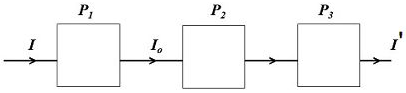
, , are three Polaroid sheets, and are two crossed polaroids. What should be the angle between Polaroids and , so that the value of
2025: 30 May Shift 2
Physics
Wave Optics
Easy
To observe diffraction, the size of an obstacle
2025: 30 May Shift 2
Physics
Wave Optics
Easy
When a wave gets refracted into a denser medium
2025: 30 May Shift 2
Physics
Wave Optics
Medium
In a double slit experiment using light of wavelength 450 nm, the angular width of a fringe formed on a distant screen is . The spacing between the two slits is
2025: 30 May Shift 1
Physics
Wave Optics
Easy
When light travels from one medium to another medium of different refractive index, then the wave will have a change in its:
2025: 30 May Shift 1
Physics
Wave Optics
Easy
In a Young's double slit experiment, the n bright fringe for a light of wavelength 5000 Å coincides with (n + 1) bright fringe for light of wavelength 4000 Å. The value of n is
2025: 30 May Shift 1
Physics
Wave Optics
Medium
In Young's double slit experiment, two slits are 2 mm apart and fringes are observed on a screen 2 m away from the slits. A light source having two wavelengths, 4000 Å and 6000 Å, is used. The minimum distance from the centre of the screen where the bright fringes produced by both wavelengths coincide is:
2025: 29 May Shift 2
Physics
Wave Optics
Easy
In an interference experiment, the two slits are 1 mm apart and the screen is placed 1 m away from the slits. The width of a bright fringe for the light of wavelength 500 nm is
2025: 29 May Shift 2
Physics
Wave Optics
Medium
The intensity ratio of the two interfering beams of light is . The value of is
2025: 29 May Shift 2
Physics
Wave Optics
Easy
Conditions for obtaining a interference pattern of light are
(A) Two waves should be coherent
(B) The distance of the screen from the slits should be small
(C) The separation between slits should be small
(D) Two coherent waves should have nearly the same amplitude
2025: 29 May Shift 2
Physics
Wave Optics
Medium
Two slits are made 0.8 mm apart and the screen is placed 1.5 m away. What should be the width of each slit to obtain 8 maxima of the double slit pattern within the central maximum of the single slit pattern?
2025: 29 May Shift 1
Physics
Wave Optics
Easy
Two parallel beams of monochromatic light pass through a long slit of width 0.2 mm one by one. The angular divergence in which most of the light is diffracted for both the beams are rad and rad respectively. If the wavelength of the first beam is 3000 Å, then the wavelength of the second beam is: