Q1:
2026: 25 May Shift 1
Physics
Atoms
Easy
If K and U represent kinetic and potential energies of an electron in an orbit of a hydrogen atom, then
Correct Answer
Option 4
Correct Answer

2026: 25 May Shift 1
Physics
Atoms
Easy
If K and U represent kinetic and potential energies of an electron in an orbit of a hydrogen atom, then
2026: 25 May Shift 1
Physics
Atoms
Easy
In a hydrogen atom, a transition of an electron takes place from n = 3 to n = 2 orbit. The energy of the emitted photon will be:
2026: 24 May Shift 1
Physics
Atoms
Medium
The energy of ground state in hydrogen atom is -13.6 eV. If the electron jumps to ground state from the 4 excited state, then the wavelength of the photon emitted will be approximately
2026: 24 May Shift 1
Physics
Atoms
Easy
Arrange the following transitions labelled as A, B, C and D, respectively (shown in the energy level diagram below) according to wavelengths of emitted photons in increasing order.
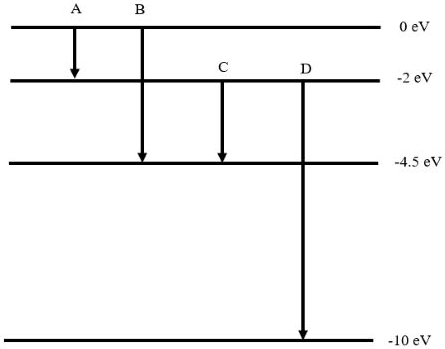
(A) 0 eV to eV
(B) 0 eV to eV
(C) eV to eV
(D) eV to eV
2026: 24 May Shift 1
Physics
Atoms
Medium
An electron in the hydrogen atom jumps from a higher energy state to the ground state. The emitted photon illuminates a photosensitive material having work function 2.75 eV. If the stopping potential of the photoelectron is 10 V, then the value of principal quantum number n characterizing the higher energy state is
2026: 22 May Shift 2
Physics
Atoms
Easy
The radius of innermost electron orbit of a hydrogen atom is m. The difference between the radii of n = 3 and n = 2 orbits is
2026: 22 May Shift 2
Physics
Atoms
Medium
Arrange the values of wavelengths of the emitted radiations in ascending order, when the electron in the hydrogen atom makes the transition between the following energy levels characterized by principal quantum number (n).
(A) n = 2 to n = 1
(B) n = 4 to n = 3
(C) n = 3 to n = 1
(D) n = 3 to n = 2
2026: 22 May Shift 2
Physics
Atoms
Easy
Arrange the speeds of the electron revolving in the orbits (characterized by their principal quantum number (n) values) of a hydrogen atom, in ascending order.
(A) n = 2
(B) n = 4
(C) n = 1
(D) n = 3
2026: 22 May Shift 1
Physics
Atoms
Easy
Match List-I with List-II
| List-I | List-II |
|---|---|
| Spectral Lines | Region |
| (A) Lyman Series | (I) Primarily near infrared Region |
| (B) Balmer Series | (II) Primarily middle Infrared Region |
| (C) Paschen Series | (III) Visible Region |
| (D) Brackett Series | (IV) Ultraviolet Region |
2026: 22 May Shift 1
Physics
Atoms
Easy
The ground state energy of hydrogen atom is -13.6 eV. The kinetic energy (K.E.) and potential energy (P.E.) of the electron in ground state are
2026: 22 May Shift 1
Physics
Atoms
Easy
An electron jumps from the fourth state to first state in a hydrogen atom. The energy released due to transition is
2026: 21 May Shift 2
Physics
Atoms
Easy
The total energy of an electron in n orbit of the hydrogen atom can be expressed as . The negative sign indicates:
2026: 21 May Shift 2
Physics
Atoms
Easy
The angular momentum (in Js units) of an electron in the 3rd orbit of hydrogen atom is :
2026: 21 May Shift 2
Physics
Atoms
Medium
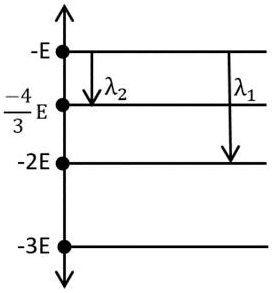
Consider the energy levels of atom as shown in the figure. The ratio of wavelengths is:
2026: 21 May Shift 1
Physics
Atoms
Medium
Arrange the following transitions of electron in hydrogen atom in the increasing order of the wavelengths associated with them.
(A) n = 2 to 1
(B) n= 3 to 2
(C) n= 3 to 1
(D) n = 4 to 2
2026: 21 May Shift 1
Physics
Atoms
Medium
In the Paschen series of the emission spectrum of the hydrogen atom, the ratio of the maximum wavelength to the minimum wavelength of spectral lines is
2026: 21 May Shift 1
Physics
Atoms
Easy
According to Bohr’s first postulate, an electron in an atom can revolve
2026: 21 May Shift 1
Physics
Atoms
Easy
Alpha particle scattering experiment determines
2026: 21 May Shift 1
Physics
Atoms
Medium
An energy of 13.6 eV is required to separate a hydrogen atom into a proton and electron.The orbital radius of the electron in hydrogen atom is
2026: 20 May Shift 2
Physics
Atoms
Medium
The energy required to excite an electron in a hydrogen atom from the first excited state to the third state is
2026: 20 May Shift 2
Physics
Atoms
Easy
If the radius of the electron orbit for n = 3 for a hydrogen atom is . The radius for n = 2 orbit is
2026: 20 May Shift 2
Physics
Atoms
Easy
Bohr's second postulate of the atomic model is related with the quantization of:
2026: 20 May Shift 2
Physics
Atoms
Easy
The ground state energy of the hydrogen atom is –13.6 eV. The kinetic energy and potential energy of the electron in this state, respectively, are:
2026: 20 May Shift 1
Physics
Atoms
Easy
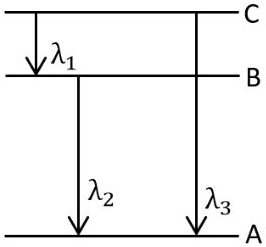
Energy levels A, B, C, of a certain atom correspond to increasing values of energy (). if , and are the wavelengths of radiations corresponding to the transitions C to B, B to A and C to A respectively, the relation between these wavelengths can be written as-
2026: 20 May Shift 1
Physics
Atoms
Easy
The kinetic energy of an electron in ground level in hydrogen atom is K units. The values of potential energy and total energy, respectively, are
2026: 20 May Shift 1
Physics
Atoms
Easy
Taking Bohr's radius as = 53 pm, the ground state radius of Li ion, on the basis of Bohr's model, will be about
2026: 20 May Shift 1
Physics
Atoms
Medium
The ratio of maximum wavelength to minimum wavelength in the Balmer series is
2026: 20 May Shift 1
Physics
Atoms
Easy
According to Bohr's model of the hydrogen atom,
(A) the radius of the orbit of an electron is directly proportional to n.
(B) the speed of the orbiting electron is directly proportional to 1/n
(C) the total energy of the electron is directly proportional to 1/n
(D) the radius of the orbit of an electron is directly proportional to n
2026: 19 May Shift 2
Physics
Atoms
Easy
According to Bohr's theory, the ratio of the kinetic energy to the total energy of the electron in a hydrogen atom at ground state is:
2026: 19 May Shift 2
Physics
Atoms
Medium
The wavelength of the first member of the Balmer series in the hydrogen spectrum is . The wavelength of first member of Lyman series will be