
Observe the image given below and answer the following questions.
Solution
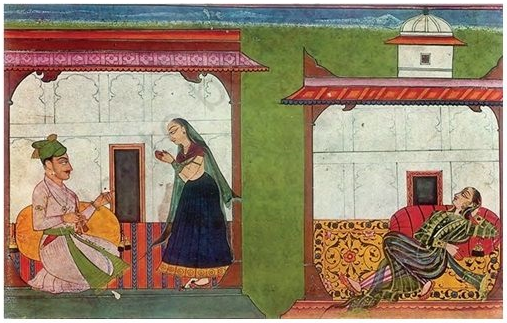
The painting shows a nayak (hero) seated on the left, a sakhi (female messenger) standing between the two, and a nayika (heroine) reclining in a separate pavilion on the right. This is a typical Pahari treatment of romantic themes such as nayika-bheda and the Rasamanjari.
Basohli (Pahari) features visible here are the flat, bright background, simple pavilions that divide the scene into compartments, strong profiles and bold, saturated colour.
Option 2: Rajasthani painting also illustrates nayikas in bold colours, but this Rasamanjari folio was painted at Basohli, in the Pahari hills.
Option 3: Deccan painting has rich, dark colours, gold and strong Persian influence, which are absent here.
Option 4: Mughal painting focuses on court scenes, portraits and naturalistic detail, not lyrical romantic episodes like this.
More from this set:
Question 41
Question 44
Question 45