Q2:

Health & Disease

Easy

Match the LIST-I with LIST-II

LIST-I DiseasesLIST-II Pathogens
A. TyphoidI. Fungus
B. MalariaII. Virus
C. Common ColdIII. Protozoa
D. Ring WormIV. Bacteria
Answer options
Option 1
Correct Answer
Explanation for 2026: 19 May Shift 2 BIO question 2

Q3:

Evolution

Medium

Match the LIST-I with LIST-II

LIST-I Placental mammalsLIST-II Australian marsupials
A. LemurI. Numbat
B. AnteaterII. Flying phalanger
C. BobcatIII. Spotted cuscus
D. Flying squirrelIV. Tasmanian tiger cat
Answer options
Option 4
Correct Answer
Explanation for 2026: 19 May Shift 2 BIO question 3

Q4:

Inheritance & Variation

Easy

What would be the genotypic ratio of red, pink and white flowers in F2F_2 generation involving monohybrid cross between red and white flower coloured plant snapdragon?

Answer options
Option 1
Correct Answer
Explanation for 2026: 19 May Shift 2 BIO question 4

Q5:

Ecosystem

Easy

Which one of the following ecological pyramids is always upright?

Answer options
Option 3
Correct Answer
Explanation for 2026: 19 May Shift 2 BIO question 5

Q7:

Inheritance & Variation

Medium

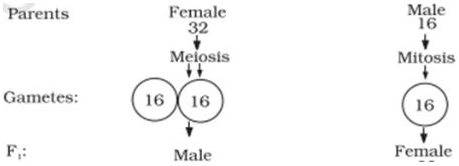
How many number of chromosome set of an individual receives after F1F_1 generation in Honey Bee?

Figure

A. 32 chromosomes in female and 16 in male

B. 16 chromosomes in male and 8 in female

C. 16 chromosomes in male and 32 in female

D. 32 chromosomes in male and 32 in male

Answer options
Option 3
Correct Answer
Explanation for 2026: 19 May Shift 2 BIO question 7

Q10:

Biotech Applications

Medium

Arrange the following steps of genetically engineered insulin production in correct sequence.

A. Preparation of two DNA sequences corresponding to A and B chains and their insertion into E.coli plasmids

B. Extraction of two chains

C. Synthesis of both chains separately

D. Joining of both insulin chains by disulfide bonds

which is the correct sequence?

Answer options

Q11:

Health & Disease

Easy

Full form of AIDS is:

Answer options

Q12:

Inheritance & Variation

Easy

A colour blind person can not differentiate between:

Answer options

Q13:

Human Reproduction

Easy

Match the LIST-I with LIST-II

LIST-I HormonesLIST-II Organs
A. TestosteroneI. Ovary
B. ProgesteroneII. Testis
C. EstrogenIII. Corpus luteum
D. GonadotropinIV. Pituitary
Answer options

Q14:

Microbes in Welfare

Easy

Match the LIST-I with LIST-II

LIST-I ProductsLIST-II Microbes
A. Lactic acidI. Clostridium butylicum
B. Citric acidII. Acetobacter aceti
C. Butyric acidIII. Lactobacillus
D. Acetic acidIV. Aspergillus niger
Answer options

Q15:

Biodiversity & Conservation

Medium

Which of the following statements are correct for seed banks?

A. They are used for preservation of gametes

B. They are useful to store seed of different genetic strains for long periods

C. They are methods of in situ conservation for animals and plants

D. They are used for ex situ conservation of medicinal plants

Answer options

Q16:

Microbes in Welfare

Easy

Which one of the following antibiotics was extensively used to treat American soldiers wounded in World War II?

Answer options

Q17:

Molecular Basis of Inheritance

Easy

The negatively charged DNA is wrapped around the positively charged histone octamer to form a structure called:

Answer options

Q18:

Evolution

Hard

Arrange the following theories of evolution in correct chronological sequence

A. Biogenesis theory

B. Big Bang Theory

C. Panspermia Theory

D. Modern theory of evolution

Choose the correct sequence of theories of evolution of life on earth from the options given below:

Answer options

Q19:

Plant Reproduction

Easy

Identify the correct sequence of events during development of seed in plants.

A. Maturation of pollen grains

B. Fertilization

C. Development of fruit

D. Pollination

Choose the correct sequence of events from the options given below

Answer options

Q20:

Inheritance & Variation

Medium

Which of the following types are meant for sex determination in animals?

A. In honey bee, sex determination in honey bee is based on the number of sets of chromosomes

B. In human, sex determination is XY type

C. In birds, sex determination is XO type

D. In grasshopper, sex determination is ZW type

Choose the correct type of sex determinations from the options given below:

Answer options

Q25:

Health & Disease

Easy

Match the LIST-I with LIST-II

LIST-I DiseasesLIST-II Confirmatory tests
A. TyphoidI. Biopsy
B. CancerII. Amniocentesis
C. AIDSIII. Widal test
D. Genetic DiseaseIV. ELISA
Answer options

Q30:

Biodiversity & Conservation

Easy

Which one of the following regions represents biodiversity hotspot?

Answer options

Q31:

Health & Disease

Medium

Innate immunity is characterized by:

A. It is present since birth

B. It prevents the microbes to enter in our body

C. It can produce antibody

D. Hydrochloric acid of stomach is a physiological barrier

Answer options

Q33:

Organisms & Populations

Easy

In a pond there were 20 lotus plants last year and through reproduction 8 new plants are added taking the current population to 28. Birth rate of lotus plant in pond is:

Answer options

Q35:

Ecosystem

Easy

Arrange the following steps of decomposition of detritus in correct sequence.

A. Leaching

B. Humification

C. Fragmentation

D. Mineralisation

Choose the correct sequence of steps of decomposition

Answer options

Q36:

Ecosystem

Easy

Arrange the following organisms in correct sequence for a grazing food chain.

A. Frog

B. Grass

C. Grasshopper

D. Snake

Answer options

Q41:

Molecular Basis of Inheritance

Easy

DNA replication

In addition to DNA-dependent DNA polymerases, many additional enzymes are required to complete the process of replication with high degree of accuracy. Since the two strands of DNA cannot be separated in its entire length (due to very high energy requirement), the replication occur within a small opening of the DNA helix, referred to as replication fork. The DNA-dependent DNA polymerases catalyse polymerisation only in one direction, that is 5′→3′5' \rightarrow 3'. This creates some additional complications at the replicating fork. Consequently, on one strand (the template with polarity 3′→5′3' \rightarrow 5' ), the replication is continuous, while on the other (the template with polarity 5′→3′5' \rightarrow 3' ), it is discontinuous. The discontinuously synthesised fragments are later joined by the enzyme DNA ligase. After the completion of replication, each DNA molecule would have one parental and one newly synthesised strand. This scheme was termed as semiconservative DNA replication. In eukaryotes replication of DNA takes place at S-Phase of cell cycle.

Fragments of DNA are joined by the enzyme -

Answer options

Q42:

Molecular Basis of Inheritance

Easy

DNA replication

In addition to DNA-dependent DNA polymerases, many additional enzymes are required to complete the process of replication with high degree of accuracy. Since the two strands of DNA cannot be separated in its entire length (due to very high energy requirement), the replication occur within a small opening of the DNA helix, referred to as replication fork. The DNA-dependent DNA polymerases catalyse polymerisation only in one direction, that is 5′→3′5' \rightarrow 3'. This creates some additional complications at the replicating fork. Consequently, on one strand (the template with polarity 3′→5′3' \rightarrow 5' ), the replication is continuous, while on the other (the template with polarity 5′→3′5' \rightarrow 3' ), it is discontinuous. The discontinuously synthesised fragments are later joined by the enzyme DNA ligase. After the completion of replication, each DNA molecule would have one parental and one newly synthesised strand. This scheme was termed as semiconservative DNA replication. In eukaryotes replication of DNA takes place at S-Phase of cell cycle.

During DNA replication, polymerisation occurs in the direction -

Answer options

Q43:

Molecular Basis of Inheritance

Easy

DNA replication

In addition to DNA-dependent DNA polymerases, many additional enzymes are required to complete the process of replication with high degree of accuracy. Since the two strands of DNA cannot be separated in its entire length (due to very high energy requirement), the replication occur within a small opening of the DNA helix, referred to as replication fork. The DNA-dependent DNA polymerases catalyse polymerisation only in one direction, that is 5′→3′5' \rightarrow 3'. This creates some additional complications at the replicating fork. Consequently, on one strand (the template with polarity 3′→5′3' \rightarrow 5' ), the replication is continuous, while on the other (the template with polarity 5′→3′5' \rightarrow 3' ), it is discontinuous. The discontinuously synthesised fragments are later joined by the enzyme DNA ligase. After the completion of replication, each DNA molecule would have one parental and one newly synthesised strand. This scheme was termed as semiconservative DNA replication. In eukaryotes replication of DNA takes place at S-Phase of cell cycle.

Mode of replication of DNA is:

Answer options

Q44:

Molecular Basis of Inheritance

Medium

DNA replication

In addition to DNA-dependent DNA polymerases, many additional enzymes are required to complete the process of replication with high degree of accuracy. Since the two strands of DNA cannot be separated in its entire length (due to very high energy requirement), the replication occur within a small opening of the DNA helix, referred to as replication fork. The DNA-dependent DNA polymerases catalyse polymerisation only in one direction, that is 5′→3′5' \rightarrow 3'. This creates some additional complications at the replicating fork. Consequently, on one strand (the template with polarity 3′→5′3' \rightarrow 5' ), the replication is continuous, while on the other (the template with polarity 5′→3′5' \rightarrow 3' ), it is discontinuous. The discontinuously synthesised fragments are later joined by the enzyme DNA ligase. After the completion of replication, each DNA molecule would have one parental and one newly synthesised strand. This scheme was termed as semiconservative DNA replication. In eukaryotes replication of DNA takes place at S-Phase of cell cycle.

E. coli has 4.6×1064.6\times10^6 bp and completes the process of replication within 18 minutes. So the average rate of polymerisation is approximately -

Answer options

Q45:

Molecular Basis of Inheritance

Easy

DNA replication

In addition to DNA-dependent DNA polymerases, many additional enzymes are required to complete the process of replication with high degree of accuracy. Since the two strands of DNA cannot be separated in its entire length (due to very high energy requirement), the replication occur within a small opening of the DNA helix, referred to as replication fork. The DNA-dependent DNA polymerases catalyse polymerisation only in one direction, that is 5′→3′5' \rightarrow 3'. This creates some additional complications at the replicating fork. Consequently, on one strand (the template with polarity 3′→5′3' \rightarrow 5' ), the replication is continuous, while on the other (the template with polarity 5′→3′5' \rightarrow 3' ), it is discontinuous. The discontinuously synthesised fragments are later joined by the enzyme DNA ligase. After the completion of replication, each DNA molecule would have one parental and one newly synthesised strand. This scheme was termed as semiconservative DNA replication. In eukaryotes replication of DNA takes place at S-Phase of cell cycle.

Replication of DNA takes place at -

Answer options

Q46:

Biotech Principles

Easy

Restriction endonucleases

The cutting of DNA at specific locations became possible with the discovery of the so-called molecular scissors'– (restriction enzymes). They cut DNA molecule at particular points by recognition a specific sequence of six base pairs. The piece of DNA was then linked with the plasmid DNA. These plasmid DNA act as vectors to transfer the piece of DNA attached to it. Each restriction endonuclease functions by ‘inspecting’ the length of a DNA sequence. Once it finds its specific recognition sequence, it will bind to the DNA and cut each of the two strands of the double helix at specific points in their sugar -phosphate backbones. Each restriction endonuclease recognizes a specific palindromic nucleotide sequences in the DNA. Palindromes are groups of letters that form the same words when read both forward and backward, e.g., “MALAYALAM”. As against a word-palindrome where the same word is read in both directions.

Restriction endonuclease enzyme used to cut:

Answer options

Q47:

Biotech Principles

Easy

Restriction endonucleases

The cutting of DNA at specific locations became possible with the discovery of the so-called molecular scissors'– (restriction enzymes). They cut DNA molecule at particular points by recognition a specific sequence of six base pairs. The piece of DNA was then linked with the plasmid DNA. These plasmid DNA act as vectors to transfer the piece of DNA attached to it. Each restriction endonuclease functions by ‘inspecting’ the length of a DNA sequence. Once it finds its specific recognition sequence, it will bind to the DNA and cut each of the two strands of the double helix at specific points in their sugar -phosphate backbones. Each restriction endonuclease recognizes a specific palindromic nucleotide sequences in the DNA. Palindromes are groups of letters that form the same words when read both forward and backward, e.g., “MALAYALAM”. As against a word-palindrome where the same word is read in both directions.

The following sequences indicates:

5'-GAATTC-3'

3'-CTTAAG-5'

Answer options

Q48:

Biotech Principles

Easy

Restriction endonucleases

The cutting of DNA at specific locations became possible with the discovery of the so-called molecular scissors'– (restriction enzymes). They cut DNA molecule at particular points by recognition a specific sequence of six base pairs. The piece of DNA was then linked with the plasmid DNA. These plasmid DNA act as vectors to transfer the piece of DNA attached to it. Each restriction endonuclease functions by ‘inspecting’ the length of a DNA sequence. Once it finds its specific recognition sequence, it will bind to the DNA and cut each of the two strands of the double helix at specific points in their sugar -phosphate backbones. Each restriction endonuclease recognizes a specific palindromic nucleotide sequences in the DNA. Palindromes are groups of letters that form the same words when read both forward and backward, e.g., “MALAYALAM”. As against a word-palindrome where the same word is read in both directions.

The first restriction endonuclease is -

Answer options

Q49:

Biotech Principles

Easy

Restriction endonucleases

The cutting of DNA at specific locations became possible with the discovery of the so-called molecular scissors'– (restriction enzymes). They cut DNA molecule at particular points by recognition a specific sequence of six base pairs. The piece of DNA was then linked with the plasmid DNA. These plasmid DNA act as vectors to transfer the piece of DNA attached to it. Each restriction endonuclease functions by ‘inspecting’ the length of a DNA sequence. Once it finds its specific recognition sequence, it will bind to the DNA and cut each of the two strands of the double helix at specific points in their sugar -phosphate backbones. Each restriction endonuclease recognizes a specific palindromic nucleotide sequences in the DNA. Palindromes are groups of letters that form the same words when read both forward and backward, e.g., “MALAYALAM”. As against a word-palindrome where the same word is read in both directions.

Which one of the following enzymes is also called as molecular scissors?

Answer options

Q50:

Biotech Principles

Easy

Restriction endonucleases

The cutting of DNA at specific locations became possible with the discovery of the so-called molecular scissors'– (restriction enzymes). They cut DNA molecule at particular points by recognition a specific sequence of six base pairs. The piece of DNA was then linked with the plasmid DNA. These plasmid DNA act as vectors to transfer the piece of DNA attached to it. Each restriction endonuclease functions by ‘inspecting’ the length of a DNA sequence. Once it finds its specific recognition sequence, it will bind to the DNA and cut each of the two strands of the double helix at specific points in their sugar -phosphate backbones. Each restriction endonuclease recognizes a specific palindromic nucleotide sequences in the DNA. Palindromes are groups of letters that form the same words when read both forward and backward, e.g., “MALAYALAM”. As against a word-palindrome where the same word is read in both directions.

DNA along with other macromolecules such as RNA, proteins, polysaccharides and lipids can be achieved by treating the bacterial cells with enzyme:

Answer options

CUET Biology 2026 19 May Shift 2 Past Year Question Paper

Every question from the CUET Biology 2026 19 May Shift 2 paper is here in full, with the correct answer and a step by step solution for each one. It is completely free, there is no login and no paywall, and you can read the whole paper online or download it to revise offline.

You can also attempt it instead of only reading it. Take the paper as a full length mock under exam conditions, or filter it by topic and attempt just that topic as a topic test. Both are free, and you get a breakdown of your accuracy, your timing and your weak areas once you submit.

CUET Biology past year questions (PYQs) are the closest thing to the real exam, so working through them is the quickest way to learn the paper pattern, the marking scheme and the level of difficulty to expect on the day.