
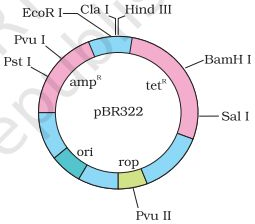
If the sequence of bases on one 'sticky end' formed by the action of EcoRI is AATT on a Vector DNA, the sequence of bases on 'sticky end' of foreign DNA to which these can join, would be:
If the sequence of bases on one 'sticky end' formed by the action of EcoRI is AATT on a Vector DNA, the sequence of bases on 'sticky end' of foreign DNA to which these can join, would be:
Solution
Sticky ends join by complementary base pairing (A with T, G with C). The vector end AATT pairs with TTAA, so the foreign DNA end must be TTAA.
EcoRI cuts both strands at the palindrome 5'-GAATTC-3', so the foreign DNA's overhang is also 5'-AATT-3'. Read in the 3' to 5' direction, this is TTAA, which is why it pairs with the vector end.
Option 1: TATA is not the complement of AATT (A would need T, T would need A, which gives TTAA, not TATA).
Option 3: identical bases (A opposite A, T opposite T) cannot pair.
Option 4: uracil (U) is found in RNA, not DNA.
Related questions:
2026: 25 May Shift 2
2026: 25 May Shift 2
2026: 22 May Shift 2
2026: 18 May Shift 1
2025: 14 May Shift 2
2026: 15 May Shift 1