CUET Biology: BiologyBiotech Principles. Free, no login required.

Q1:

2026: 19 May Shift 2

Biotech Principles

Easy

Restriction endonucleases

The cutting of DNA at specific locations became possible with the discovery of the so-called molecular scissors'– (restriction enzymes). They cut DNA molecule at particular points by recognition a specific sequence of six base pairs. The piece of DNA was then linked with the plasmid DNA. These plasmid DNA act as vectors to transfer the piece of DNA attached to it. Each restriction endonuclease functions by ‘inspecting’ the length of a DNA sequence. Once it finds its specific recognition sequence, it will bind to the DNA and cut each of the two strands of the double helix at specific points in their sugar -phosphate backbones. Each restriction endonuclease recognizes a specific palindromic nucleotide sequences in the DNA. Palindromes are groups of letters that form the same words when read both forward and backward, e.g., “MALAYALAM”. As against a word-palindrome where the same word is read in both directions.

The following sequences indicates:

5'-GAATTC-3'

3'-CTTAAG-5'
Answer options
Option 1
Correct Answer
Explanation for 2026: 19 May Shift 2 BIO question 1

Q2:

2026: 19 May Shift 2

Biotech Principles

Easy

Restriction endonucleases

The cutting of DNA at specific locations became possible with the discovery of the so-called molecular scissors'– (restriction enzymes). They cut DNA molecule at particular points by recognition a specific sequence of six base pairs. The piece of DNA was then linked with the plasmid DNA. These plasmid DNA act as vectors to transfer the piece of DNA attached to it. Each restriction endonuclease functions by ‘inspecting’ the length of a DNA sequence. Once it finds its specific recognition sequence, it will bind to the DNA and cut each of the two strands of the double helix at specific points in their sugar -phosphate backbones. Each restriction endonuclease recognizes a specific palindromic nucleotide sequences in the DNA. Palindromes are groups of letters that form the same words when read both forward and backward, e.g., “MALAYALAM”. As against a word-palindrome where the same word is read in both directions.

The first restriction endonuclease is -

Answer options
Option 2
Correct Answer
Explanation for 2026: 19 May Shift 2 BIO question 2

Q3:

2026: 19 May Shift 2

Biotech Principles

Easy

Restriction endonucleases

The cutting of DNA at specific locations became possible with the discovery of the so-called molecular scissors'– (restriction enzymes). They cut DNA molecule at particular points by recognition a specific sequence of six base pairs. The piece of DNA was then linked with the plasmid DNA. These plasmid DNA act as vectors to transfer the piece of DNA attached to it. Each restriction endonuclease functions by ‘inspecting’ the length of a DNA sequence. Once it finds its specific recognition sequence, it will bind to the DNA and cut each of the two strands of the double helix at specific points in their sugar -phosphate backbones. Each restriction endonuclease recognizes a specific palindromic nucleotide sequences in the DNA. Palindromes are groups of letters that form the same words when read both forward and backward, e.g., “MALAYALAM”. As against a word-palindrome where the same word is read in both directions.

Which one of the following enzymes is also called as molecular scissors?

Answer options
Option 3
Correct Answer
Explanation for 2026: 19 May Shift 2 BIO question 3

Q4:

2026: 19 May Shift 2

Biotech Principles

Easy

Restriction endonucleases

The cutting of DNA at specific locations became possible with the discovery of the so-called molecular scissors'– (restriction enzymes). They cut DNA molecule at particular points by recognition a specific sequence of six base pairs. The piece of DNA was then linked with the plasmid DNA. These plasmid DNA act as vectors to transfer the piece of DNA attached to it. Each restriction endonuclease functions by ‘inspecting’ the length of a DNA sequence. Once it finds its specific recognition sequence, it will bind to the DNA and cut each of the two strands of the double helix at specific points in their sugar -phosphate backbones. Each restriction endonuclease recognizes a specific palindromic nucleotide sequences in the DNA. Palindromes are groups of letters that form the same words when read both forward and backward, e.g., “MALAYALAM”. As against a word-palindrome where the same word is read in both directions.

DNA along with other macromolecules such as RNA, proteins, polysaccharides and lipids can be achieved by treating the bacterial cells with enzyme:

Answer options
Option 2
Correct Answer
Explanation for 2026: 19 May Shift 2 BIO question 4

Q5:

2026: 19 May Shift 1

Biotech Principles

Easy

Gel electrophoresis

The cutting of DNA by restriction endonucleases results in the fragments of DNA. These fragments can be separated by a technique known as gel electrophoresis. Since DNA fragments are negatively charged molecules they can be separated by forcing them to move towards the anode under an electric field through a medium/matrix. Nowadays the most commonly used matrix is agarose which is a natural polymer extracted from sea weeds. The DNA fragments separate according to their size through sieving effect provided by the agarose gel. Hence, smaller the fragment size, farther it moves. The separated DNA fragments can be visualised only after staining the DNA with a compound followed by exposure to UV radiation. You can see bright orange coloured bands of DNA in a gel exposed to UV light. The separated bands of DNA are cut out from the agarose gel and extracted from the gel piece. This step is known as elution. The DNA fragments purified in this way are used in constructing recombinant DNA by joining them with cloning vectors.

Ethidium bromide stains -

Answer options
Option 2
Correct Answer
Explanation for 2026: 19 May Shift 1 BIO question 5

Q6:

2026: 19 May Shift 1

Biotech Principles

Easy

Gel electrophoresis

The cutting of DNA by restriction endonucleases results in the fragments of DNA. These fragments can be separated by a technique known as gel electrophoresis. Since DNA fragments are negatively charged molecules they can be separated by forcing them to move towards the anode under an electric field through a medium/matrix. Nowadays the most commonly used matrix is agarose which is a natural polymer extracted from sea weeds. The DNA fragments separate according to their size through sieving effect provided by the agarose gel. Hence, smaller the fragment size, farther it moves. The separated DNA fragments can be visualised only after staining the DNA with a compound followed by exposure to UV radiation. You can see bright orange coloured bands of DNA in a gel exposed to UV light. The separated bands of DNA are cut out from the agarose gel and extracted from the gel piece. This step is known as elution. The DNA fragments purified in this way are used in constructing recombinant DNA by joining them with cloning vectors.

In gel electrophoresis, DNA fragments move towards -

Answer options
Option 2
Correct Answer
Explanation for 2026: 19 May Shift 1 BIO question 6

Q7:

2026: 19 May Shift 1

Biotech Principles

Easy

Gel electrophoresis

The cutting of DNA by restriction endonucleases results in the fragments of DNA. These fragments can be separated by a technique known as gel electrophoresis. Since DNA fragments are negatively charged molecules they can be separated by forcing them to move towards the anode under an electric field through a medium/matrix. Nowadays the most commonly used matrix is agarose which is a natural polymer extracted from sea weeds. The DNA fragments separate according to their size through sieving effect provided by the agarose gel. Hence, smaller the fragment size, farther it moves. The separated DNA fragments can be visualised only after staining the DNA with a compound followed by exposure to UV radiation. You can see bright orange coloured bands of DNA in a gel exposed to UV light. The separated bands of DNA are cut out from the agarose gel and extracted from the gel piece. This step is known as elution. The DNA fragments purified in this way are used in constructing recombinant DNA by joining them with cloning vectors.

In gel electrophoresis, DNA fragments are separated according to -

Answer options
Option 2
Correct Answer
Explanation for 2026: 19 May Shift 1 BIO question 7

Q8:

2026: 19 May Shift 1

Biotech Principles

Easy

Gel electrophoresis

The cutting of DNA by restriction endonucleases results in the fragments of DNA. These fragments can be separated by a technique known as gel electrophoresis. Since DNA fragments are negatively charged molecules they can be separated by forcing them to move towards the anode under an electric field through a medium/matrix. Nowadays the most commonly used matrix is agarose which is a natural polymer extracted from sea weeds. The DNA fragments separate according to their size through sieving effect provided by the agarose gel. Hence, smaller the fragment size, farther it moves. The separated DNA fragments can be visualised only after staining the DNA with a compound followed by exposure to UV radiation. You can see bright orange coloured bands of DNA in a gel exposed to UV light. The separated bands of DNA are cut out from the agarose gel and extracted from the gel piece. This step is known as elution. The DNA fragments purified in this way are used in constructing recombinant DNA by joining them with cloning vectors.

One can see _________ coloured bands of DNA in a ethidium bromide stained gel exposed to UV light.

Answer options
Option 4
Correct Answer
Explanation for 2026: 19 May Shift 1 BIO question 8

Q9:

2026: 19 May Shift 1

Biotech Principles

Easy

Gel electrophoresis

The cutting of DNA by restriction endonucleases results in the fragments of DNA. These fragments can be separated by a technique known as gel electrophoresis. Since DNA fragments are negatively charged molecules they can be separated by forcing them to move towards the anode under an electric field through a medium/matrix. Nowadays the most commonly used matrix is agarose which is a natural polymer extracted from sea weeds. The DNA fragments separate according to their size through sieving effect provided by the agarose gel. Hence, smaller the fragment size, farther it moves. The separated DNA fragments can be visualised only after staining the DNA with a compound followed by exposure to UV radiation. You can see bright orange coloured bands of DNA in a gel exposed to UV light. The separated bands of DNA are cut out from the agarose gel and extracted from the gel piece. This step is known as elution. The DNA fragments purified in this way are used in constructing recombinant DNA by joining them with cloning vectors.

Elution in gel electrophoresis means -

Answer options
Option 3
Correct Answer
Explanation for 2026: 19 May Shift 1 BIO question 9

Q10:

2026: 18 May Shift 1

Biotech Principles

Easy

Which one of the following conditions is not involved for achieving the desired product in bioreactor?

Answer options

Q11:

2026: 18 May Shift 1

Biotech Principles

Easy

Which one of the followings is not a correct combination of enzyme and organism used for breaking the cells?

Answer options

Q13:

2026: 18 May Shift 1

Biotech Principles

Easy

Which one of the followings is not used as a selectable marker for E.coli, involved in recombinant DNA technology?

Answer options

Q14:

2026: 18 May Shift 1

Biotech Principles

Easy

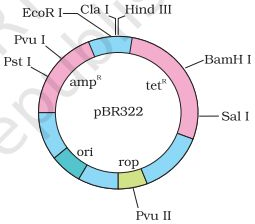
In the following figure of E.coli cloning vector pBR322, which one of the followings codes for the proteins?

Figure

Answer options

Q15:

2026: 15 May Shift 1

Biotech Principles

Easy

Which one of the following statements is incorrect about gel electrophoresis?

Answer options

Q17:

2026: 15 May Shift 1

Biotech Principles

Easy

A procedure through which a piece of DNA is introduced into a host bacterium is:

Answer options

Q19:

2026: 15 May Shift 1

Biotech Principles

Medium

Which of the following statements are correct regarding isolation of DNA?

A. DNA ultimately precipitates after the addition of chilled ethanol.

B. Separated DNA can be removed by autoradiography.

C. The RNA can be removed by treatment with ribonuclease.

D. DNA can be released from the cell along with other macromolecules by treating it with enzymes.

Answer options

Q20:

2026: 14 May Shift 2

Biotech Principles

Easy

Restriction endonuclease

Hind II always cuts DNA molecules at a particular point by recognizing a specific sequence of six base pairs. Besides Hind II, today we know more than 900 restriction enzymes that have been isolated from over 230 strains of bacteria, each of which recognizes different recognition sequence. The convention for naming these enzymes is the first letter of the name comes from the genus and the second two letters come from the species of the prokaryotic cell from which they were isolated. Roman numbers following the names indicate the order in which the enzymes were isolated from that strain of bacteria. Restriction enzymes belong to a larger class of enzymes called nucleases. These are of two kinds: exonucleases and endonucleases. Exonucleases remove nucleotides from the ends of DNA, whereas endonucleases make cuts at specific positions within the DNA. Each restriction endonuclease functions by 'inspecting' the length of a DNA sequence. Once it finds its specific recognition sequence, it will bind to the DNA and cuts each of the two strands of the double helix at specific points in their sugar-phosphate backbones. Each restriction endonuclease recognizes a specific palindromic nucleotide sequence in the DNA.These are groups of letters that form the same word when read both forward and backward, e.g., "MALAYALAM".

Restriction endonucleases cut DNA at specific points in -

Answer options

Q21:

2026: 14 May Shift 2

Biotech Principles

Easy

Restriction endonuclease

Hind II always cuts DNA molecules at a particular point by recognizing a specific sequence of six base pairs. Besides Hind II, today we know more than 900 restriction enzymes that have been isolated from over 230 strains of bacteria, each of which recognizes different recognition sequence. The convention for naming these enzymes is the first letter of the name comes from the genus and the second two letters come from the species of the prokaryotic cell from which they were isolated. Roman numbers following the names indicate the order in which the enzymes were isolated from that strain of bacteria. Restriction enzymes belong to a larger class of enzymes called nucleases. These are of two kinds: exonucleases and endonucleases. Exonucleases remove nucleotides from the ends of DNA, whereas endonucleases make cuts at specific positions within the DNA. Each restriction endonuclease functions by 'inspecting' the length of a DNA sequence. Once it finds its specific recognition sequence, it will bind to the DNA and cuts each of the two strands of the double helix at specific points in their sugar-phosphate backbones. Each restriction endonuclease recognizes a specific palindromic nucleotide sequence in the DNA.These are groups of letters that form the same word when read both forward and backward, e.g., "MALAYALAM".

The recognition sequence of Hind II is-

Answer options

Q22:

2026: 14 May Shift 2

Biotech Principles

Easy

Restriction endonuclease

Hind II always cuts DNA molecules at a particular point by recognizing a specific sequence of six base pairs. Besides Hind II, today we know more than 900 restriction enzymes that have been isolated from over 230 strains of bacteria, each of which recognizes different recognition sequence. The convention for naming these enzymes is the first letter of the name comes from the genus and the second two letters come from the species of the prokaryotic cell from which they were isolated. Roman numbers following the names indicate the order in which the enzymes were isolated from that strain of bacteria. Restriction enzymes belong to a larger class of enzymes called nucleases. These are of two kinds: exonucleases and endonucleases. Exonucleases remove nucleotides from the ends of DNA, whereas endonucleases make cuts at specific positions within the DNA. Each restriction endonuclease functions by 'inspecting' the length of a DNA sequence. Once it finds its specific recognition sequence, it will bind to the DNA and cuts each of the two strands of the double helix at specific points in their sugar-phosphate backbones. Each restriction endonuclease recognizes a specific palindromic nucleotide sequence in the DNA.These are groups of letters that form the same word when read both forward and backward, e.g., "MALAYALAM".

Restriction endonucleases cut DNA -

Answer options

Q23:

2026: 14 May Shift 2

Biotech Principles

Medium

Restriction endonuclease

Hind II always cuts DNA molecules at a particular point by recognizing a specific sequence of six base pairs. Besides Hind II, today we know more than 900 restriction enzymes that have been isolated from over 230 strains of bacteria, each of which recognizes different recognition sequence. The convention for naming these enzymes is the first letter of the name comes from the genus and the second two letters come from the species of the prokaryotic cell from which they were isolated. Roman numbers following the names indicate the order in which the enzymes were isolated from that strain of bacteria. Restriction enzymes belong to a larger class of enzymes called nucleases. These are of two kinds: exonucleases and endonucleases. Exonucleases remove nucleotides from the ends of DNA, whereas endonucleases make cuts at specific positions within the DNA. Each restriction endonuclease functions by 'inspecting' the length of a DNA sequence. Once it finds its specific recognition sequence, it will bind to the DNA and cuts each of the two strands of the double helix at specific points in their sugar-phosphate backbones. Each restriction endonuclease recognizes a specific palindromic nucleotide sequence in the DNA.These are groups of letters that form the same word when read both forward and backward, e.g., "MALAYALAM".

The Palindrome in DNA can be defined as -

Answer options

Q24:

2026: 14 May Shift 2

Biotech Principles

Medium

Restriction endonuclease

Hind II always cuts DNA molecules at a particular point by recognizing a specific sequence of six base pairs. Besides Hind II, today we know more than 900 restriction enzymes that have been isolated from over 230 strains of bacteria, each of which recognizes different recognition sequence. The convention for naming these enzymes is the first letter of the name comes from the genus and the second two letters come from the species of the prokaryotic cell from which they were isolated. Roman numbers following the names indicate the order in which the enzymes were isolated from that strain of bacteria. Restriction enzymes belong to a larger class of enzymes called nucleases. These are of two kinds: exonucleases and endonucleases. Exonucleases remove nucleotides from the ends of DNA, whereas endonucleases make cuts at specific positions within the DNA. Each restriction endonuclease functions by 'inspecting' the length of a DNA sequence. Once it finds its specific recognition sequence, it will bind to the DNA and cuts each of the two strands of the double helix at specific points in their sugar-phosphate backbones. Each restriction endonuclease recognizes a specific palindromic nucleotide sequence in the DNA.These are groups of letters that form the same word when read both forward and backward, e.g., "MALAYALAM".

Which one of the following is a palindromic sequence?

Answer options

Q25:

2026: 14 May Shift 1

Biotech Principles

Easy

BIOTECHNOLOGY : PRINCIPLES AND PROCESSES

The first constructed recombinant DNA emerged from the possibility of linking a gene encoding antibiotic resistance with a native autonomously replicating circular extra-chromosomal DNA of Salmonella typhimurium. Stanley Cohen and Herbert Boyer accomplished this by isolating the antibiotic resistance gene by cutting out a piece of DNA from a plasmid which was responsible for conferring antibiotic resistance. The cutting of DNA at specific locations became possible with the discovery of the so-called 'molecular scissors'. The two enzymes responsible for restricting the growth of bacteriophage in Escherichia coli were isolated. One of these added methyl groups to DNA, while the other cut DNA. The later was called restriction endonuclease. The cut piece of DNA was then linked with the plasmid DNA. These plasmid DNA act as vectors to transfer the piece of DNA attached to it.

Autonomously replicating circular extra-chromosomal DNA is known as:

Answer options

Q26:

2026: 14 May Shift 1

Biotech Principles

Easy

BIOTECHNOLOGY : PRINCIPLES AND PROCESSES

The first constructed recombinant DNA emerged from the possibility of linking a gene encoding antibiotic resistance with a native autonomously replicating circular extra-chromosomal DNA of Salmonella typhimurium. Stanley Cohen and Herbert Boyer accomplished this by isolating the antibiotic resistance gene by cutting out a piece of DNA from a plasmid which was responsible for conferring antibiotic resistance. The cutting of DNA at specific locations became possible with the discovery of the so-called 'molecular scissors'. The two enzymes responsible for restricting the growth of bacteriophage in Escherichia coli were isolated. One of these added methyl groups to DNA, while the other cut DNA. The later was called restriction endonuclease. The cut piece of DNA was then linked with the plasmid DNA. These plasmid DNA act as vectors to transfer the piece of DNA attached to it.

For the construction of the first recombinant DNA, Stanley Cohen and Herbert Boyer used the organism -

Answer options

Q27:

2026: 14 May Shift 1

Biotech Principles

Easy

BIOTECHNOLOGY : PRINCIPLES AND PROCESSES

The first constructed recombinant DNA emerged from the possibility of linking a gene encoding antibiotic resistance with a native autonomously replicating circular extra-chromosomal DNA of Salmonella typhimurium. Stanley Cohen and Herbert Boyer accomplished this by isolating the antibiotic resistance gene by cutting out a piece of DNA from a plasmid which was responsible for conferring antibiotic resistance. The cutting of DNA at specific locations became possible with the discovery of the so-called 'molecular scissors'. The two enzymes responsible for restricting the growth of bacteriophage in Escherichia coli were isolated. One of these added methyl groups to DNA, while the other cut DNA. The later was called restriction endonuclease. The cut piece of DNA was then linked with the plasmid DNA. These plasmid DNA act as vectors to transfer the piece of DNA attached to it.

Identify the enzyme which is useful for cutting DNA at specific locations.

Answer options

Q28:

2026: 14 May Shift 1

Biotech Principles

Easy

BIOTECHNOLOGY : PRINCIPLES AND PROCESSES

The first constructed recombinant DNA emerged from the possibility of linking a gene encoding antibiotic resistance with a native autonomously replicating circular extra-chromosomal DNA of Salmonella typhimurium. Stanley Cohen and Herbert Boyer accomplished this by isolating the antibiotic resistance gene by cutting out a piece of DNA from a plasmid which was responsible for conferring antibiotic resistance. The cutting of DNA at specific locations became possible with the discovery of the so-called 'molecular scissors'. The two enzymes responsible for restricting the growth of bacteriophage in Escherichia coli were isolated. One of these added methyl groups to DNA, while the other cut DNA. The later was called restriction endonuclease. The cut piece of DNA was then linked with the plasmid DNA. These plasmid DNA act as vectors to transfer the piece of DNA attached to it.

DNA fragments can be separated by a technique known as:

Answer options

Q29:

2026: 14 May Shift 1

Biotech Principles

Easy

BIOTECHNOLOGY : PRINCIPLES AND PROCESSES

The first constructed recombinant DNA emerged from the possibility of linking a gene encoding antibiotic resistance with a native autonomously replicating circular extra-chromosomal DNA of Salmonella typhimurium. Stanley Cohen and Herbert Boyer accomplished this by isolating the antibiotic resistance gene by cutting out a piece of DNA from a plasmid which was responsible for conferring antibiotic resistance. The cutting of DNA at specific locations became possible with the discovery of the so-called 'molecular scissors'. The two enzymes responsible for restricting the growth of bacteriophage in Escherichia coli were isolated. One of these added methyl groups to DNA, while the other cut DNA. The later was called restriction endonuclease. The cut piece of DNA was then linked with the plasmid DNA. These plasmid DNA act as vectors to transfer the piece of DNA attached to it.

Which one of the following enzymes is the first restriction endonuclease?

Answer options

Q30:

2025: 2 June Shift 2

Biotech Principles

Easy

Arrange the given steps involved in Polymerase Chain Reaction in correct sequence?

(A) Annealing

(B) Extension

(C) Denaturation

(D) Amplification

Answer options