
Please log in to comment and participate in discussions.
Comments (4)
B
basicallybhavesh
IIM Ranchi (IR 2)
MOD•10mos
Feel free to share the screenshot of the solution attached with this question and let us know which part was confusing -- we'll help elucidate the same!
1
K
kabirkepohe
•10mos
isn't it coming (b) only?
1
S
solulu
•10mos
why am i getting both b and c
2
IPMAT/Algebra
Academic discussion and doubt solving for: Progression & Series, Inequalities, Linear Equation, Functions, Modulus, Minima & Maxima, Polynomials, Identities, Indices
1693Members
103
Online
Members can post and comment here, and get these posts in their Latest feed.
Moderators
Join AfterBoards
Create an account to join our community and participate in discussions.
- • Connect with peers
- • Resolve doubts
- • Learn more about admissions
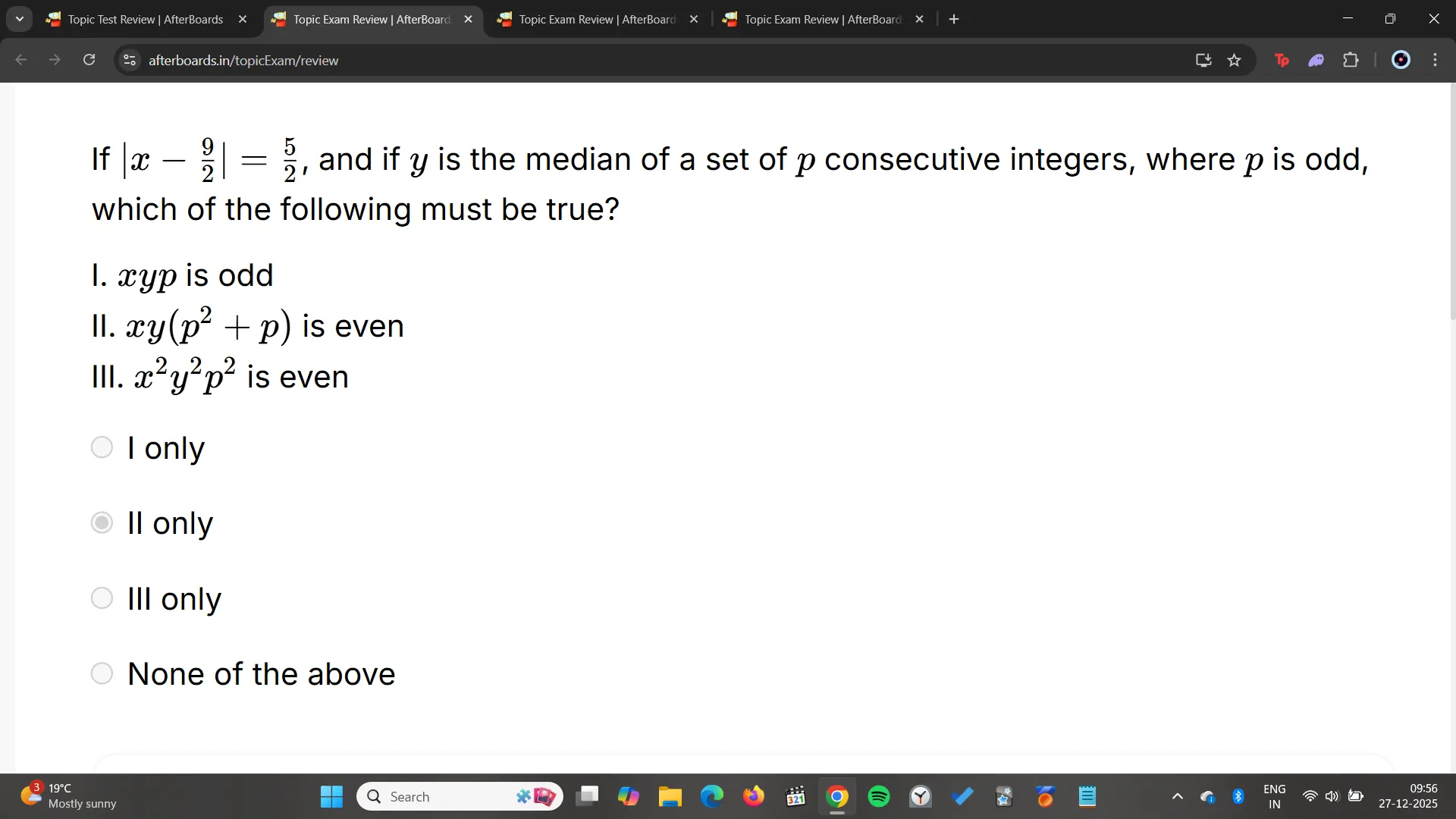
|x -9/2| = 5/2 is either x-9/2=5/2 or x-9/2=-5/2
so x=7 or 2 respectively. x can be odd or even.
since p is an odd integer and y is the median of p consecutive intergers so y can be odd or even
option 1 states that xyp is odd, now for xyp to be odd all the factors must be odd. Which is not true because x can be 2.
option 2 states that xy(p^2+p) must be even. Now for this to be even any one of the factors must be even. We know that p is a odd integer, so the square of p must be odd too. And adding p to p^2 (odd+odd) makes the sum even. Hence option 2 is correct.
(since option 2 is already proven to be correct, we don't have to check the other options, but still I am doing it for the sake of clarity, and to be sure.)
option 3 states that x^2y^2p^2 is even. So if we can prove that any one of the terms is even this too becomes true. We know p is odd. x can be 2 or 7, so we are not sure wether x is odd or even. Simmilarly y too can be odd or even depending on the number of terms. Hence we are not sure if this will be odd or even.
Hence option 2 is correct!
I hope this explanation helped you understand!