
Am I interpreting the question correctly or is the solution provided wrong?
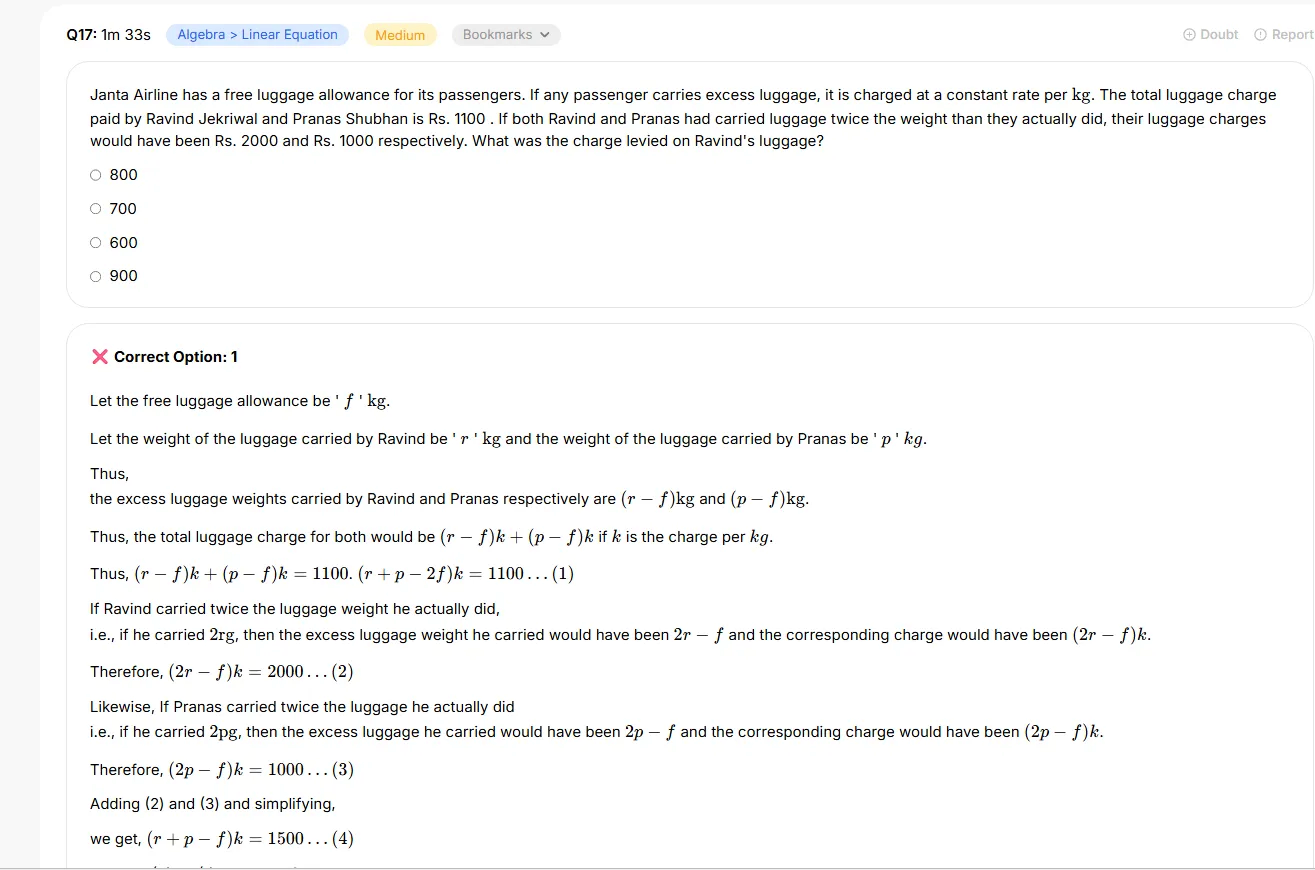 Originally Ravind was carrying (r+f)kgs and Pranas was carrying (p+f)kgs.
Now, if they were carrying luggage twice the weight than the original then
Ravind would be carrying 2(r+f)kgs and
Pranas would be carrying 2(p+f)kgs
Then their excess weights would be 2r+f and 2p+f respectively. Why does the question state 2r-f and 2p-f
The solution has assumed the new wait to be 2r+f and 2p+f kgs I believe but nowhere in the question has it been mentioned that we have to take double of the excess weight only.
Please log in to comment and participate in discussions.
Comments (1)
Academic discussion and doubt solving for: Progression & Series, Inequalities, Linear Equation, Functions, Modulus, Minima & Maxima, Polynomials, Identities, Indices
Members can post and comment here, and get these posts in their Latest feed.
Moderators
Join AfterBoards
Create an account to join our community and participate in discussions.
- • Connect with peers
- • Resolve doubts
- • Learn more about admissions
You are wrong in assuming that the new weights become 2(r + f) and 2(p + f). In the solution, r and p are already defined as the total luggage weights carried by Ravind and Pranas. The free allowance is f kg, so the chargeable excess luggage is calculated as total luggage minus the free allowance, which is (r − f) and (p − f). That is why the original charge is based on (r − f)k and (p − f)k.
When the question says they carried twice the weight they actually did, it simply means their total luggage becomes 2r and 2p. The free allowance f does not change because the airline’s free allowance is fixed. Therefore, the new excess weights become (2r − f) and (2p − f). Your interpretation adds f again by writing 2r + f, which is incorrect because r already includes the free allowance portion of the luggage.